Types of AI agents: from simple reflex to multi-agent systems
The classic types of AI agents explained with business examples, and the practical types you can buy or build in 2026: assistants, workflow agents, coding agents, computer-use agents and multi-agent systems.
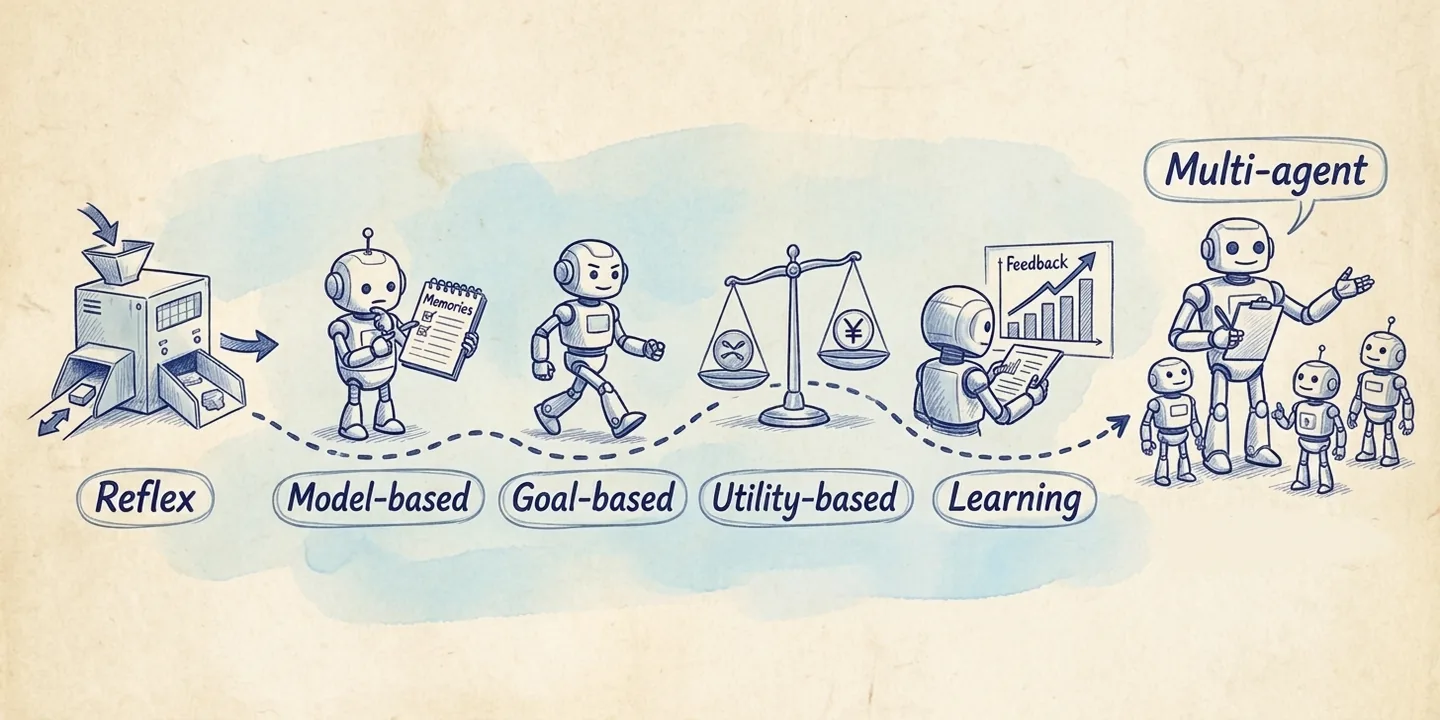
“AI agent” covers everything from a thermostat rule to a team of models that plans a product launch. Knowing the types helps in two ways: you can tell what a vendor is really selling, and you can pick the simplest type that solves your problem. Simpler types are cheaper, faster and easier to trust.
This article covers the classic types from computer science, each with a business example, and then the practical types you will meet when you buy or build agents in 2026.
The classic types
The textbook classification, popularised by Russell and Norvig’s Artificial Intelligence: A Modern Approach, sorts agents by how they decide what to do. It predates language models, but it still describes real systems well.
Simple reflex agents
They react to the current input with a fixed rule: if this, then that. They have no memory and no plan.
Business example: an email rule that sends every message containing “invoice” to accounting. A language model can make the “if” smarter (“is this email about an invoice, in any language?”), but the agent is still a reflex: one input, one reaction.
Good for: high-volume, low-risk routing where every case is independent.
Model-based reflex agents
They keep an internal picture of the situation, so they can react to things they cannot see right now.
Business example: a support assistant that remembers the order number from earlier in the conversation and the fact that the customer already tried a reset, so it does not ask again.
Good for: conversations and processes where context changes the right answer.
Goal-based agents
They have a goal and plan a sequence of actions to reach it. They compare options by asking “does this get me closer to the goal?”
Business example: an agent asked to “prepare the documents for this client’s onboarding”. It works out which forms are missing, requests them, fills what it can and reports what is left.
Good for: multi-step tasks where the path depends on the case. Most modern LLM agents are goal-based.
Utility-based agents
They do not just reach the goal, they choose the best way to reach it according to a score: cost, speed, risk or customer satisfaction.
Business example: a scheduling agent that can book a technician for tomorrow at a higher cost or next week at a lower one, and picks based on the contract’s priority and the customer’s history.
Good for: decisions with trade-offs, where “done” has better and worse versions.
Learning agents
They improve from feedback. A learning element changes how the agent behaves based on what worked and what did not.
Business example: a triage agent whose routing rules are reviewed every month against the cases people had to reassign, with the corrections fed back into its instructions and examples.
Good for: stable, repeated tasks with clear feedback. In practice, most “learning” in business agents happens through people updating prompts, examples and tools based on logs, not through the model retraining itself.
The practical types in 2026
Product categories cut across the textbook types. These are the ones you will actually be offered.
| Type | What it does | Typical tools | Main risk |
|---|---|---|---|
| Conversational assistant | Answers and acts inside a chat | Knowledge base, order lookup, booking | Wrong answers stated confidently |
| Workflow agent | Runs inside a business process, often without a chat | CRM, ERP, email, documents | Silent errors in the middle of a process |
| Coding agent | Reads, changes and tests code | Files, terminal, test runner, Git | Changes that pass tests but miss the intent |
| Research agent | Reads many sources and writes a summary | Web search, document search | Missed or misread sources |
| Computer-use agent | Operates a screen like a person: clicks, types, reads | Browser, desktop | Acting on the wrong page or field |
| Multi-agent system | Several agents split a large task | Any of the above | Coordination cost and hard debugging |
Conversational assistants
The most visible type: a chat on a website, in WhatsApp or inside an app. The good ones are model-based and goal-based: they keep context and can complete a task, such as moving an appointment, not just answer. See AI bot architecture: from scripted chatbot to agent.
Workflow agents
They work behind the scenes: an invoice arrives, the agent reads it, matches it to the order, flags differences and prepares the entry. There is no chat, and that is the danger: nobody watches each step, so you need checks, logs and alerts for cases that get stuck. See AI for APIs and workflows.
Coding agents
They are the most mature agent type, because code gives fast, objective feedback: it compiles or not, tests pass or fail. A coding agent can take an issue, change several files, run the tests and open a pull request for review. The person’s role moves from typing code to describing the change well and reviewing it carefully.
Research agents
They search, read and compare. They are useful for market scans, due diligence or answering a question across hundreds of internal documents. Their output is only as good as their sources, so ask for references you can check. For internal documents, a private RAG server is usually the backbone.
Computer-use agents
They see a screen and operate it: open a site, fill a form, download a report. They help where there is no API, such as an old supplier portal. They are slower and more fragile than an API integration, and they need tight limits on which sites and actions are allowed.
Multi-agent systems
A lead agent splits a large task and hands parts to specialised agents: one researches, one drafts, one checks. This helps when a task is too large for one context or benefits from parallel work. It also multiplies cost and makes failures harder to trace. Start with one agent and split only when you can show that one agent cannot do the job.
How to choose the right type
Work from the simplest option up:
- Can a rule do it? Use a rule or a reflex agent.
- Does it need context from earlier steps? Use a model-based assistant.
- Does the path depend on the case? Use a goal-based agent with a small set of tools.
- Are there trade-offs to optimise? Add a utility score: cost, deadline or risk.
- Is the task too big for one agent? Only then consider multiple agents.
At each step, ask how a mistake would be caught. The more autonomous the type, the more you need tests, approvals and logs. See autonomous AI agents for how to set the right level of autonomy.
Example: one process, several types
Take a small distribution company that receives orders by email, in different formats, from regular customers.
- A simple reflex agent sorts incoming emails: orders to the order inbox, invoices to accounting, everything else to the general inbox. One input, one decision, no memory.
- A model-based agent reads each order email and keeps track of the conversation: if the customer writes “same as last week, but double the quantity”, it looks up last week’s order before extracting the lines.
- A goal-based agent takes each extracted order to completion: it checks stock, finds substitutes for missing products from an approved list, prepares the order in the ERP and drafts a confirmation for a person to send.
- A utility-based decision appears when stock is split across two warehouses: the agent compares delivery time and transport cost and picks the option that best fits the customer’s contract.
- The learning part is the monthly review: the team looks at the orders people had to correct and updates the instructions, the substitute list and the examples.
Nothing here needs a multi-agent system. One well-designed agent with a handful of tools, plus a rule-based sorter in front of it, covers the whole flow. That is typical: the types are layers you combine, not products you choose between.
Frequently asked questions
Which type do most companies need?
A goal-based agent with three to five well-designed tools, running inside a clear process, covers most first projects. Multi-agent systems are rarely the right first step.
Are LLM agents “learning agents”?
Not on their own. A model does not change after each task. Improvement comes from you: reviewing logs, fixing instructions, adding examples and adjusting tools.
Is a computer-use agent better than an API integration?
No. If the system has an API, use it: it is faster, cheaper and more reliable. Computer use is a fallback for systems you cannot integrate otherwise.
Can one agent be several types at once?
Yes. A support assistant can be model-based in conversation, goal-based when it completes a booking and utility-based when it picks the cheapest delivery option.
What to bring to a first conversation
Bring the task, a few real examples, the systems involved and the decisions that must stay with a person. Together we can place the task on the scale above and start with the simplest type that works. For a broader introduction, see what AI agents are.
Sources
- Stuart Russell and Peter Norvig, Artificial Intelligence: A Modern Approach, chapter on intelligent agents
- Anthropic: Building effective agents
- OWASP Top 10 for LLM Applications