Autonomous AI agents: how much freedom to give them, and how to stay in control
Autonomy is a setting, not a feature. Five levels of autonomy for AI agents, the guardrails each level needs, and a practical way to increase freedom step by step without losing control.
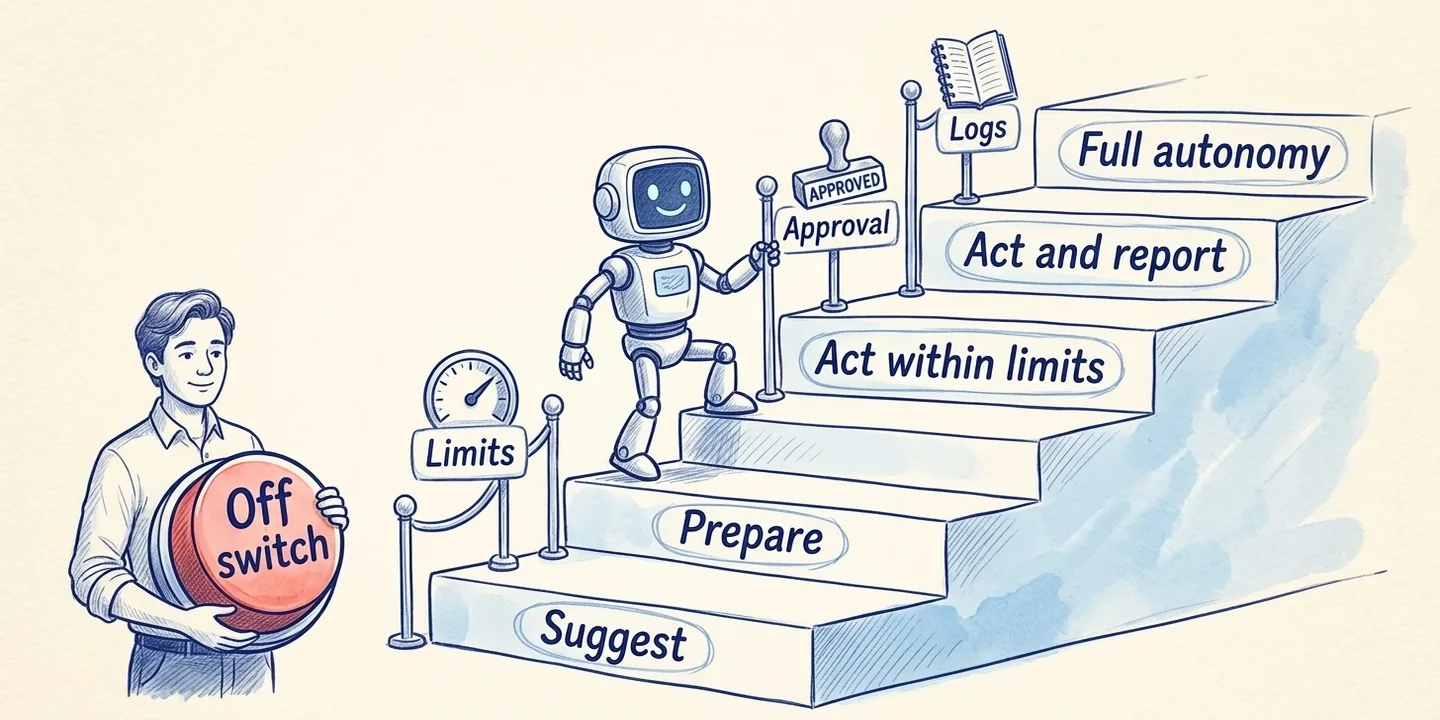
An autonomous AI agent works toward a goal without asking for permission at every step. It decides what to do, does it, checks the result and continues. That is exactly what makes agents useful, and exactly what makes companies nervous.
The good news is that autonomy is not all or nothing. It is a setting you choose for each task and each action, and you can raise it gradually as the agent earns trust. This article gives you a simple scale, the guardrails each level needs and a way to move up the scale safely.
Five levels of autonomy
| Level | What the agent does | Who decides | Example |
|---|---|---|---|
| 1. Suggest | Proposes an answer or action | A person, every time | Drafts a reply for an agent to send |
| 2. Prepare | Does the work up to the final step | A person approves the last step | Prepares a refund for approval |
| 3. Act within limits | Acts alone inside clear rules | The rules; a person handles exceptions | Refunds duplicates up to a set amount |
| 4. Act and report | Acts broadly, reports afterwards | A person reviews samples and alerts | Triages and resolves most tickets overnight |
| 5. Full autonomy | Sets sub-goals and acts across systems | Nobody, during the run | Rare in business; mostly research settings |
Most valuable business agents today live at levels 2 and 3. Level 4 works for well-understood, reversible tasks with good monitoring. Level 5 is rarely a good idea for anything that touches money, customers or production systems.
The level is per action, not per agent. The same agent can search and read at level 4, draft emails at level 2 and never delete anything without a person.
What makes autonomy safe
Autonomy is safe when three things are true: mistakes are unlikely, mistakes are caught quickly and mistakes can be undone. Each guardrail below supports one of these.
Narrow tools
Give the agent tools that do one thing with clear limits. A tool called refund_duplicate_payment with a maximum amount is far safer than a general call_payment_api. Narrow tools also make the agent’s choices easier to read in the logs.
Least privilege
The agent’s credentials should allow only what the task needs: read access where reading is enough, write access to one table instead of the whole database, one mailbox instead of the whole domain. If the agent is tricked or confused, the damage stays small. See AI system security: prompt injection and permissions.
Approval gates
Mark the actions that need a person: sending to customers, payments above a limit, deleting data, changing access. The agent prepares the action and pauses; a person approves or edits it. Good gates show the person exactly what will happen and why, so approval takes seconds, not minutes.
Budgets and stop conditions
Set limits on steps, time and spend for each task. An agent that has called the same tool twenty times without progress should stop and report, not keep trying. Budgets turn an expensive loop into a clear “I could not finish, here is what I found”.
Logs you can read
Record every step: what the agent saw, what it decided, which tool it called with which inputs and what came back. You need this to explain a decision to a customer, to debug a failure and to decide when an agent is ready for more autonomy.
A way back
Every autonomous action needs an undo path: a refund can be reversed, a draft deleted, a change rolled back. For actions that cannot be undone, the answer is usually an approval gate.
An off switch
Someone must be able to stop the agent immediately, and the business must keep working when it is stopped. That means the manual process still exists and people still know it.
How to raise autonomy step by step
- Start in shadow mode. The agent runs on real cases but only records what it would do. People keep working normally. Compare its choices with theirs.
- Move to suggestions. The agent proposes; people accept, edit or reject. Track the acceptance rate and the kind of edits.
- Allow narrow actions. Let the agent act alone on the most common, lowest-risk case type, with a limit. Everything else still goes to a person.
- Review samples, not everything. Once error rates are low and stable, review a random sample and every case that triggers an alert.
- Expand one case type at a time. Each new case type starts again at suggestion level.
Decide the criteria for moving up before you start: for example, “two weeks of suggestions with at least a set acceptance rate and no serious errors”. Otherwise the decision becomes a feeling.
Where autonomous agents work well
- Overnight queues. Classifying and resolving routine tickets so the team starts the day with only the exceptions.
- Data upkeep. Finding duplicates, filling missing fields from approved sources, flagging inconsistencies.
- Software maintenance. Updating dependencies, fixing failing tests and opening pull requests that a developer reviews.
- Monitoring. Watching metrics and logs, investigating anomalies and writing a first analysis before a person is paged.
They work poorly where goals are vague, success is hard to check or a single mistake is very costly.
Autonomy and regulation
In the EU, the AI Act requires human oversight for high-risk AI systems and transparency when people interact with AI. Even outside high-risk uses, the GDPR applies whenever an agent processes personal data, including the rules on automated decisions with significant effects on people. Design approval gates and logs with these in mind from the start; adding them later is harder. See AI security, the AI Act and GDPR.
A worked example: autonomy for a refund agent
Consider an online shop whose support team handles refund requests. The agent can read orders, payments and the refund policy, and it has one action tool: create a refund.
Weeks 1-2, shadow mode. For every request, the agent records what it would do and why. The team works as usual. At the end, they compare: on which cases did the agent agree with the team, and where did it not? Most disagreements turn out to be cases the policy does not describe clearly, so the policy gets two new rules.
Weeks 3-4, suggestions. The agent now prepares each refund and a short explanation; a person approves with one click or edits it. The team tracks how many suggestions are accepted unchanged and what kind of edits they make.
Weeks 5-8, narrow autonomy. For one case type, duplicate charges below a set amount, the agent creates the refund on its own and posts a note on the ticket. Everything else still goes to a person. A daily alert lists any refund above the usual pattern.
After that, sampling. Once the autonomous case type shows a stable, low error rate, the team reviews a random sample each week instead of every case, and the next case type, such as damaged items with a photo, starts again at suggestion level.
At no point did the agent get a general “issue refunds” permission. Its freedom grew one case type at a time, each backed by data from the step before.
Common mistakes
- Giving autonomy because the demo looked good. A demo shows the easy cases. Autonomy should follow measured results on real ones.
- One autonomy level for the whole agent. Reading and acting carry very different risks; set the level per action.
- Alerts nobody owns. An alert without a named person and a clear action is noise. Decide who responds and what they do.
- Letting the manual process fade. If the agent is switched off and nobody remembers how to do the work, you have created a new single point of failure.
Frequently asked questions
Can an autonomous agent run without anyone watching?
For a narrow, reversible, well-monitored task, yes, within limits. Someone still owns the agent, reviews samples, handles alerts and can stop it.
How do I stop an agent from going off track?
Narrow tools, clear stop conditions, step and cost budgets, and instructions that say what to do when unsure: stop and ask, rather than guess.
Is more autonomy always more efficient?
No. Each step up saves review time but raises the cost of mistakes. The right level is the one where the time saved clearly exceeds the risk.
Who is responsible when an autonomous agent makes a mistake?
The company that deployed it. That is why ownership, approval rules and logs need to be clear before launch, not after the first incident.
What to bring to a first conversation
Bring the task, the actions the agent would take, which of them can be undone and which mistakes would be expensive. From that we can set the autonomy level per action and plan the path from shadow mode to production. For the basics, see what AI agents are, and for running agents reliably, AI systems in production.