Managing a Hybrid Team of 3 Developers and 5 AI Agents: A Fractional CTO’s Daily Routine
Your engineering team is no longer just humans. How to lead a hybrid team of 3 engineers and 5 specialized AI agents: decision supervision, who reviews what, AI cost management, and what a Fractional CTO still does that AI cannot.
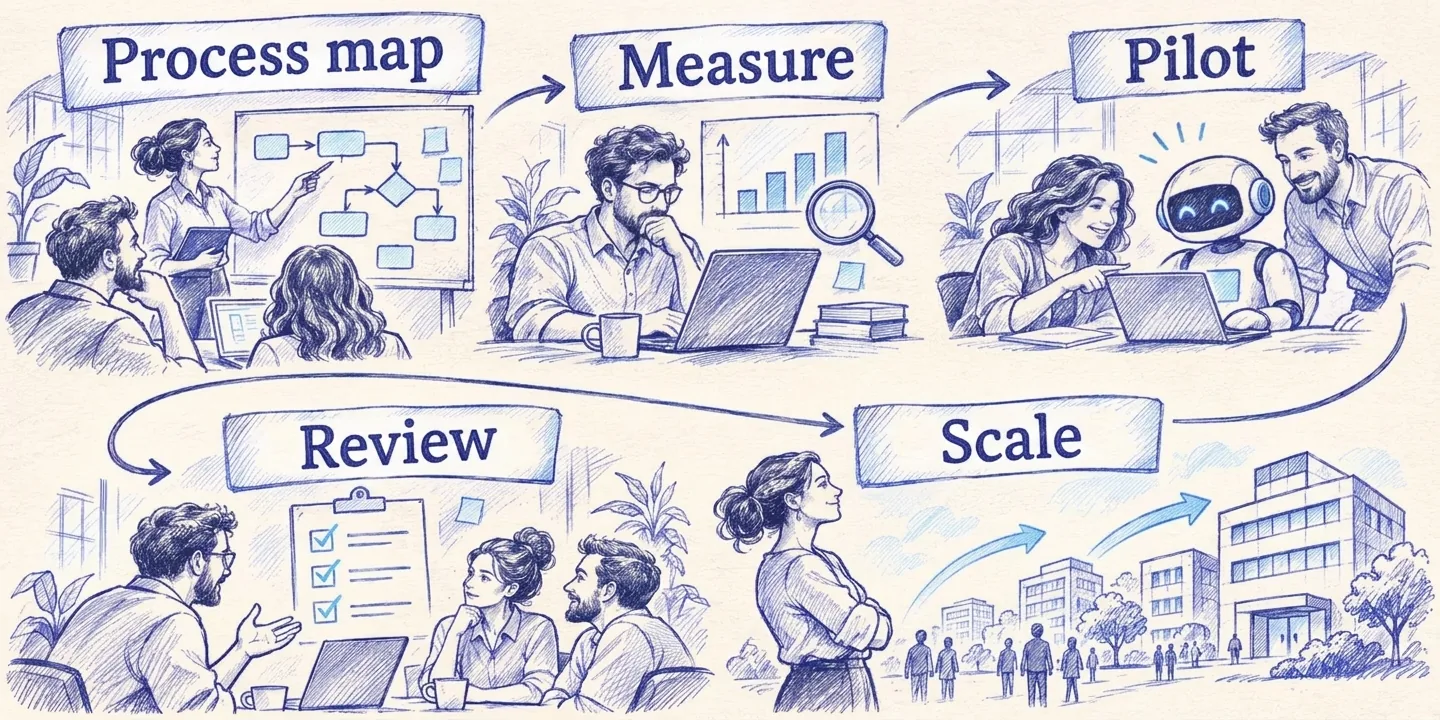
The quietest management shift of 2026 is that your org chart no longer lists everyone doing the work. On paper, a product engineering pod I lead might look like a lean four-person team: one Fractional CTO / Product Owner and three full-stack engineers. In daily operation, that pod runs as a hybrid team of four humans and five specialized AI agents—handling codebase discovery, implementation drafts, edge-case test generation, automated security/PR review, and production telemetry triage. That hybrid pod ships the volume of work that used to require twelve to fifteen people, at a fraction of the burn rate.
Yet many founders and engineering managers who try to run this model end up exhausted, watching their senior developers drown in noisy pull requests while their cloud and token bills climb every month. Why? Because they manage a hybrid team using 2020 habits built for human task execution. When autonomous agents join the workflow, management shifts from supervising task execution to supervising decisions, boundaries, and economics. Here is what that shift looks like inside a real hybrid team, hour by hour.
Key takeaways
- Decision supervision replaces task tracking: You no longer spend standups asking “Are you 60% done writing the boilerplate?” Boilerplate takes twenty minutes. You spend leadership energy checking what we chose to build, which invariants we locked down, and whether the verification evidence proves the change is safe.
- Treat each agent as a narrow specialist with a named human owner: In our 3-human + 5-agent pod, every agent has a restricted toolset, a clear job description, a step/cost budget, and a specific human engineer accountable for its outputs.
- Review capacity—not coding speed—is your new constraint: Because 3 engineers with agents can generate 10x more code than 3 engineers typing by hand, undisciplined teams collapse under review debt. Strict PR size caps and automated pre-review gates keep human judgment fresh.
- AI cost management is a core engineering discipline: In 2026, a Tech Lead tracks token burn per merged PR and inference cost per customer transaction right alongside AWS/Cloudflare spend and database latency.
- What a Fractional CTO / Product Owner does that AI cannot: Aligning technology with commercial survival, saying “no” to the wrong features, designing trust and compliance boundaries, negotiating trade-offs under ambiguity, and taking legal and commercial responsibility for outcomes.
Anatomy of a 2026 hybrid pod: 3 humans + 5 specialized AI agents
When founders hear “5 AI agents on the engineering team,” they sometimes picture five autonomous digital employees chatting in Slack with human avatars. In production engineering, anthropomorphizing agents is a mistake. You do not want five generalists with vague personalities; you want five deterministic workflow specialists, each triggered at a specific stage of the Agentic SDLC and supervised by a named human.
Here is the exact division of labor inside a 3-developer + 5-agent product squad:
| Role | Type | Primary Responsibility | What It Can Do Autonomously | Who Reviews & Owns the Output |
|---|---|---|---|---|
| Product Owner / Fractional CTO | Human (Lead) | Commercial priorities, system architecture, risk/compliance boundaries, final release gates. | Sets roadmap, locks architectural specs, approves high-risk changes, owns budget. | Accountable to the Founder / CEO / Client. |
| 3 Full-Stack Product Engineers | Humans | Domain design, complex stateful logic, orchestrating coding agents, reviewing diffs, customer UX. | Write specs, steer implementation agents, review and merge PRs, own production on-call. | Peer-reviewed; accountable to the CTO/PO. |
| Agent 1: Repo & Spec Explorer | Read-only Agent | Scans codebase, DB schemas, and issue history to draft impact analyses and technical specs. | Reads code, searches git blame, maps affected endpoints and data tables. (Zero write access.) | Engineer writing the feature spec. |
| Agent 2: Worktree Builder | Coding Agent | Implements bounded feature slices, migrations, and API/UI wiring inside an isolated Git worktree. | Edits files in its branch, runs compiler/unit tests in a local sandbox until green. | The engineer who spawned the worktree task. |
| Agent 3: Adversarial Test Writer | Verification Agent | Reads the spec (not the implementation) and writes edge-case, permission, and regression tests. | Creates unit, integration, and Playwright test files; flags untested failure branches. | The engineer owning the PR before human review. |
| Agent 4: Guardrail & PR Reviewer | Review Agent | Audits every opened PR against AGENTS.md, OWASP rules, tenant isolation, and query performance. |
Posts inline review comments and blocks CI if hard invariants or migrations fail. | The senior reviewer (never replaces human sign-off). |
| Agent 5: Telemetry & Ops Triager | Ops Agent | Watches production logs, Server-Timing, and error alerts; correlates spikes with recent commits. |
Queries read-only logs/metrics, drafts root-cause summaries and reproduction tests. | On-call engineer (human approves any hotfix/rollback). |
Look at why this ratio (3 humans to 5 narrow agents) works so well:
- Zero shared confusion: Agent 1 cannot edit code. Agent 4 cannot push commits. Agent 5 cannot restart production servers. Each agent has the minimum permissions required for its single job.
- Every agent output has a human throat to choke: If Agent 2 writes a sloppy database query and Engineer B merges it without reading the diff, Engineer B owns that bug—never “the agent.”
My daily routine managing a hybrid team of humans and agents
To make this concrete, here is what a typical workday looks like when I act as Fractional CTO or Product Owner for a hybrid team:
08:30 – 09:00: Overnight telemetry, cost check, and triage review
Before opening Slack or email, I review a single 15-minute operational digest prepared by Agent 5 (Telemetry & Ops Triager):
- Production health & SLA exceptions: Any 5xx spikes, slow D1/PostgreSQL queries, or failed webhook deliveries over the last 24 hours, already grouped by root cause and linked to the suspect commit.
- Production AI agent metrics (if the product runs customer-facing agents): Task completion rate, human escalation rate, and any guardrail/budget trips.
- Engineering & runtime AI FinOps: Yesterday’s total token and compute spend broken down by environment (development coding agents vs. staging evaluation runs vs. production customer traffic). If a developer’s background loop burned €35 on a single branch yesterday, we see it at 08:40 AM, not at the end of the month.
09:00 – 10:15: Spec lock and architectural boundaries (the highest-leverage hour)
In a hybrid team, the morning starts with specifications, not coding. If three engineers start their day with vague requirements, they will launch three coding agents in the wrong direction and spend the afternoon undoing 2,000 lines of generated code.
Together with the three engineers, we review the 3 to 5 bounded specs prepared with the help of Agent 1 (Repo & Spec Explorer). In 75 minutes, we lock down:
- Which tasks are pure deterministic code and which touch an AI model or external integration.
- The exact database migration and rollback path.
- Which security invariants apply (tenant ID checks, rate limits, idempotency keys, GDPR PII handling).
- The exact acceptance criteria that Agent 3 (Adversarial Test Writer) will test against.
Once a spec is locked (usually a 40-line checklist on the ticket), the engineer is cleared to spin up Agent 2 (Worktree Builder).
10:15 – 13:00: Deep execution and decision supervision
During the mid-day build block, each of the three engineers typically runs two parallel workstreams:
- Workstream A (Human-hands-on): Designing a high-complexity state machine, tuning a UX interaction, or debugging a subtle distributed-systems race condition where human intuition beats any LLM.
- Workstream B (Agent-delegated in a secondary worktree): Delegating a well-specified API endpoint, data migration, admin CRUD view, or integration wrapper to Agent 2 and Agent 3.
My job during this block is decision supervision. When an engineer or an agent hits an architectural fork in the road—“Should we store this audit state in the main transactional table or an append-only event log?” or “Should this external vendor timeout fail open or fail closed?”—we resolve the decision in five minutes so the build loop never stalls on guesswork.
14:00 – 15:30: The two-stage code review gate
By early afternoon, the morning’s workstreams have produced 4 to 6 pull requests. In a traditional team, 6 pull requests a day from 3 developers would either be tiny trivial tweaks or an unreviewable mountain of code.
Here is how we review 6 substantial PRs in 90 minutes without lowering quality:
- Gate 1 (Automated + Agent 4): Before any human is tagged for review, CI must be 100% green, Agent 3’s adversarial edge-case tests must pass, and Agent 4 (Guardrail & PR Reviewer) must have posted its security and architecture audit with zero unresolved high-severity flags. If Gate 1 fails, the author engineer fixes it in their worktree first.
- Gate 2 (Human architecture & logic review): Because Gate 1 already verified syntax, formatting, types, null checks, and standard OWASP rules, the human reviewer spends 15 focused minutes per PR checking three things an AI reviewer still misses:
- Does this code actually solve the business problem the customer has?
- Are the tests proving real behavior, or did the coding agent write a clever mock that hides a bug?
- Does this change keep the codebase simple for the next six months, or did the agent add unnecessary abstraction layers?
16:00 – 17:00: Customer alignment, backlog pruning, and “saying no”
The last hour of the day belongs to product leadership: reviewing staging deployments with stakeholders, checking user conversion and retention metrics, and pruning the backlog. When building features gets three times faster, the biggest danger to a software product is feature bloat—shipping twenty mediocre features just because your agents can generate them quickly. Keeping the product sharp means deleting low-value ideas ruthlessly. For more on how management priorities shift when introducing AI, see Management in the AI era.
Who reviews what? The 4-rule review protocol for hybrid teams
If you lead a team where developers use coding agents daily, put these four rules in your engineering handbook this week:
- The “No Orphan Code” Rule: There is no such thing as “AI-authored code” in git history. Every commit and every pull request has a single human engineer’s name on it. If you cannot explain how a function works during code review in thirty seconds without reading the prompt, you are not allowed to submit the PR.
- The 400-Line Diff Ceiling: Agents can happily generate a 2,200-line diff in ten minutes. Humans cannot review a 2,200-line diff with high accuracy; after line 400, human attention drops off a cliff and rubber-stamping begins (“LGTM”). Force engineers to slice agent work into stacked PRs of 150 to 400 lines.
- Separate the Builder Prompt from the Tester Prompt: Never ask the same agent session that wrote the implementation code to be the sole author of the acceptance tests—it will test its own blind spots. Use a clean context (or a second developer) seeded only with the specification and the public interface to write the edge-case tests.
- Hard Human Sign-Off on Four Protected Zones: Configure
CODEOWNERSso that any diff touching (a) authentication/permissions middleware, (b) database migrations, (c) payment/billing logic, or (d) external AI prompt/tool guardrails requires explicit sign-off from the CTO or Tech Lead.
AI cost management: the new discipline every Tech Lead owns
In 2022, a reckless engineering team could accidentally run up a surprise AWS bill by leaving oversized EC2 instances running. In 2026, a reckless hybrid team runs up a surprise AI compute bill across three separate buckets:
- Developer agent burn (SDLC cost): Engineers running frontier models in infinite loops over unindexed repositories.
- CI and evaluation burn: Running LLM-as-a-judge evaluations on 500 test cases on every single git commit instead of gating full evaluations on release branches.
- Production runtime burn: Customer-facing or back-office agents retrying failed tool calls or stuffing 80,000 tokens of unpruned RAG documents into every turn.
As a Fractional CTO, I treat AI cost as a first-class engineering metric with a simple monthly budget table (illustrative figures for a 3-developer + 5-agent pod building and running a B2B SaaS product):
| Cost Bucket | Unmanaged Hybrid Team (Common 2026 Trap) | Disciplined Hybrid Team (Managed FinOps) | Key Control Lever |
|---|---|---|---|
| 1. Engineering coding agents (3 devs) | €1,800 / mo (unbounded loops, frontier models for trivial edits) | €450 / mo (€150/dev with model tiering & 15-turn caps) | Spec first; frontier model for planning/review, fast model for edits. |
| 2. CI & automated evaluation suites | €950 / mo (full LLM eval suite on every push) | €140 / mo (deterministic unit tests on push; full LLM eval on release/prompt diffs) | Only run LLM evals when prompts, tools, or RAG pipelines change. |
| 3. Production customer/ops agents | €4,200 / mo (raw JSON in context, no prompt cache, retry loops) | €780 / mo (narrow MCP tools, 65% prompt cache, step budgets) | Track cost per completed task and alert on p95 token spikes. |
| Total Monthly AI Spend | €6,950 / month | €1,370 / month | 80% reduction with higher reliability. |
For the exact formula to calculate and cap production workflow budgets, see How much AI automation costs.
Fractional CTO in the AI era: what I still do that AI cannot
A fair question every founder asks in 2026 is: “If AI agents can explore codebases, draft architectures, write TypeScript and Python, generate tests, and review pull requests, why do I still need a Fractional CTO or senior Product Owner?”
Because software engineering was never primarily about typing code—it is about making irreversible commercial, architectural, and organizational bets under uncertainty. After twenty years of building software and leading teams, here are the five jobs I do every week that no model can take off a founder’s plate:
- Translating messy commercial reality into the right 20% of scope: An AI agent will happily build whatever feature you ask for—even if that feature destroys your onboarding conversion, violates an enterprise customer’s procurement rules, or takes six weeks to solve a problem a 10-line SQL view could solve today. Deciding what not to build is still the highest-ROI decision in software.
- Designing system boundaries and data ownership: Models are brilliant at local tactics (writing a module) and poor at long-term system invariants (where tenant boundaries live, how billing state stays consistent when a webhook fails halfway through, when to split a service vs. keep a modular monolith).
- Setting the trust, security, and EU AI Act posture: An AI agent cannot sign a Data Processing Agreement, stand in front of an enterprise client’s CISO during a security audit, or take legal accountability under the EU AI Act and GDPR.
- Coaching engineers from “coders” into “system orchestrators”: Junior and mid-level developers need active mentorship to develop architectural taste—learning how to spot when an agent’s plausible-looking code hides a subtle concurrency bug or security flaw.
- Owning the outcome when things break: When a critical production incident hits during a product launch, you need a calm human leader who knows the architecture end-to-end, coordinates the rollback, communicates transparently with enterprise customers, and fixes the root process so it stays fixed.
What to bring to a first conversation
If you are a founder or engineering leader running a small team that needs the output of a much larger department—or if your team has adopted AI coding tools but delivery still feels chaotic, slow, or expensive—bring your current team structure, your product roadmap for the next 90 days, and your biggest delivery bottleneck. Whether you need a Fractional Product Owner / Tech Lead for a few days a month or hands-on software architecture to transition your team to an Agentic SDLC, we can map a concrete 30-day plan on our first call.