EU AI Act for Founders: August 2026 Rules and Why Governance Wins Enterprise Deals
In August 2026, the EU AI Act's main obligations and Article 99 penalties take full effect. A 10-minute checklist for Romanian and EU startups, runtime agent governance in code, and how compliance closes enterprise contracts faster.
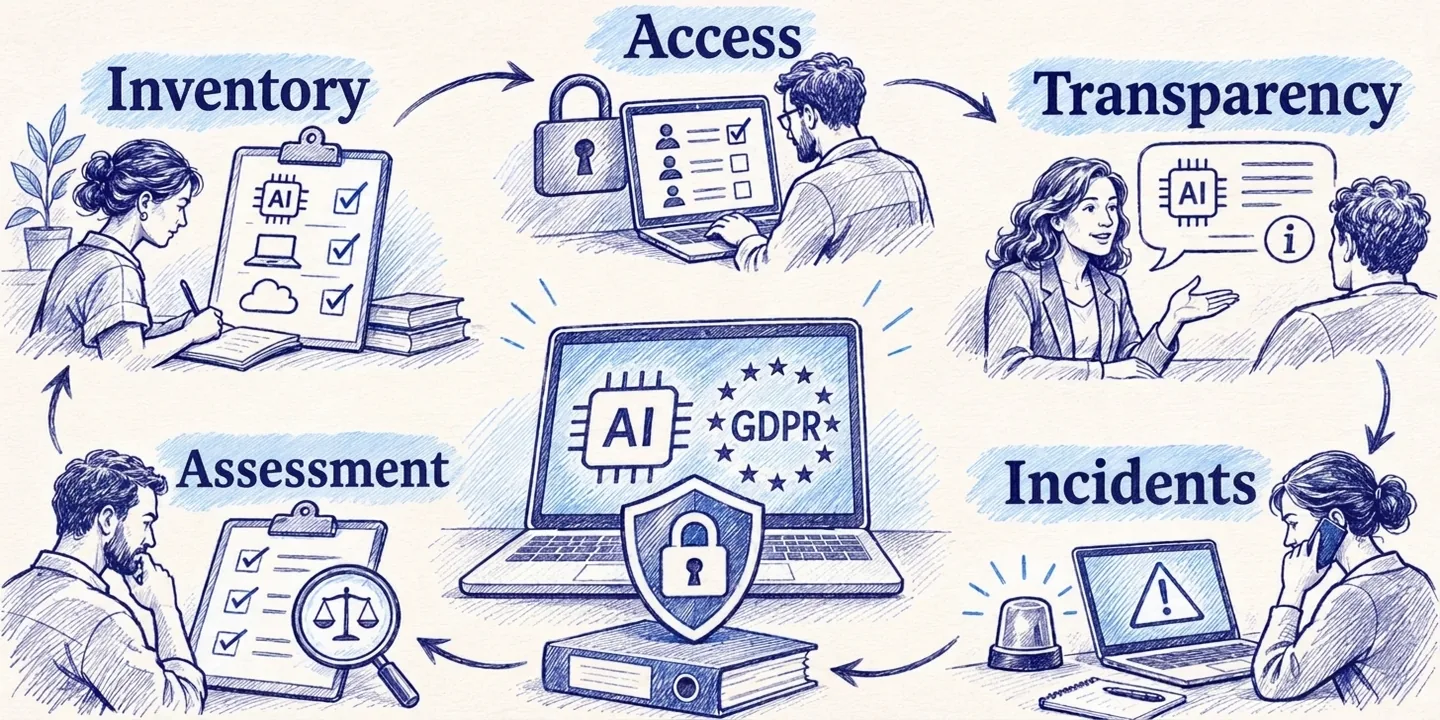
In 2024 and 2025, AI governance was mostly a PDF policy that sat in a Google Drive folder until an investor asked for it. In 2026, governance is executable code, an enforceable legal obligation in the European Union, and the single biggest gatekeeper in B2B enterprise sales. With the EU AI Act (Regulation (EU) 2024/1689) crossing its main August 2, 2026 enforcement milestone—and Article 99 administrative fines reaching up to €15 million or 3% of global annual turnover for high-risk obligations (and up to €35 million or 7% for prohibited practices)—regulators and enterprise procurement teams no longer accept promises. They ask for technical proof: risk classification records, runtime permission bounds, immutable execution logs, data lineage, and a tested human kill switch.
For a Romanian or European software founder, it is tempting to treat this as bureaucratic friction. In practice, I see the exact opposite across B2B deals: governance is how a 10-person company beats a 200-person competitor in enterprise procurement. When an enterprise buyer’s DPO and CISO ask how your AI feature prevents data leakage, enforces human oversight, and logs automated decisions, being able to hand them a two-page technical architecture dossier and a live audit-log export closes in two weeks a security review that otherwise drags on for six months.
Note: This article is an engineering and product management guide based on Regulation (EU) 2024/1689 and GDPR, not formal legal counsel. For high-risk systems or binding legal opinions, always validate your classification with qualified legal counsel.
Key takeaways
- August 2026 made the EU AI Act operational: Prohibitions and AI literacy (Feb 2025) and GPAI rules (Aug 2025) were the warm-up; as of August 2026, Annex III high-risk obligations, Article 50 transparency rules, and Article 99 penalty tiers (€15M / 3% for non-compliance with high-risk/operator duties; €35M / 7% for banned practices) are live realities.
- Most B2B software is not “High-Risk,” but your enterprise buyers still demand high-risk controls: Even if your SaaS or internal assistant falls under limited/minimal risk, selling into finance, healthcare, HR, critical infrastructure, or large EU enterprises triggers procurement questionnaires modeled directly on Annex III and ISO/IEC 42001.
- Governance-by-design lives in your database and agent harness, not in a slide deck: Automatic trace logging (Article 12), human-in-the-loop override gates (Article 14), and explicit AI disclosure (Article 50) must be built into the codebase from sprint one.
- Shadow AI is the #1 internal blind spot: Roughly 75% of organizations lack comprehensive visibility into which external AI tools employees and scripts are feeding company data into.
- CEO and founder accountability is explicit: Delegating AI compliance to a junior developer without clear risk appetite, tool allowlists, and incident runbooks leaves leadership personally exposed when a contract audit or data incident occurs.
The EU AI Act timeline and penalty tiers at a glance
If you build, integrate, or deploy AI systems in Romania or anywhere in the EU single market—even if your servers or model providers are in the US—the EU AI Act applies whenever the output of the system is used inside the Union. Here is where the enforcement timeline stands in late 2026 and what each tier requires:
| Risk Tier & Articles | Examples in Business & SaaS | Status in Late 2026 | Maximum Penalty (Art. 99) |
|---|---|---|---|
| Prohibited AI Practices (Art. 5) | Emotion recognition in the workplace/schools, untargeted facial scraping, manipulative subliminal scoring, social scoring. | In force (since Feb 2, 2025) | Up to €35,000,000 or 7% of worldwide annual turnover (higher of the two; proportional caps for SMEs). |
| High-Risk AI Systems — Annex III (Art. 6–49) | AI used for CV screening, recruitment, worker performance evaluation, creditworthiness / credit scoring, life & health insurance pricing, critical infrastructure, education scoring. | In force (from Aug 2, 2026) | Up to €15,000,000 or 3% of worldwide annual turnover (SME cap: lower of the two amounts under Art. 99(6)). |
| Transparency Obligations (Art. 50) | Customer chatbots, AI voice agents, synthetic media/deepfakes, AI-generated public text on matters of public interest. | In force (from Aug 2, 2026) | Up to €15,000,000 or 3% of worldwide annual turnover. |
| General-Purpose AI (GPAI) Models (Art. 51–56) | Foundation model providers (OpenAI, Anthropic, Google, Mistral). Fine-tuners who substantially modify a GPAI model can inherit provider duties. | In force (since Aug 2, 2025) | Up to €15,000,000 or 3% of worldwide annual turnover (Art. 101). |
| Minimal / Standard B2B Risk | Internal code assistants, B2B invoice extraction, inventory forecasting, draft generation with human review, search/RAG over technical manuals. | Active (AI literacy Art. 4 + GDPR still apply in full) | Governed by GDPR (up to €20M / 4%) and contractual B2B SLAs. |
Notice an important detail in Article 99(6) that many founders miss: while large enterprises face whichever fine is higher (the euro figure or the turnover percentage), SMEs and startups are capped at whichever of the two amounts is lower. However, even a 1% to 3% turnover fine—or an order from a national market surveillance authority to pull your product offline until logging and human oversight are fixed—can be fatal to a growing company.
The 10-minute EU AI Act checklist for a Romanian or EU startup
Before you launch an AI product feature or deploy an internal agent, walk through these ten questions with your Product Owner and Tech Lead. It takes ten minutes and tells you immediately which engineering and legal controls you need:
- Role check (Provider vs. Deployer): Are we placing our own AI system on the market under our brand name (Provider), or are we using an AI system inside our own company operations (Deployer)? Note: if you take a third-party foundation model via API, wrap it in your own system prompt, tools, and UI, and sell it to clients as a HR or credit-scoring tool, you are the Provider of that high-risk AI system (Article 25).
- Prohibited check (Article 5): Does any feature infer employee emotions from video/voice/text at work, scrape biometric images, or exploit vulnerable groups? If yes, kill the feature immediately.
- Annex III High-Risk check (Article 6): Does the system screen job applicants, evaluate employees for promotion/termination, score consumer creditworthiness, price health/life insurance, or control physical safety components?
- Look closely at the Article 6(3) procedural exception: an Annex III system is not considered high-risk if it only performs a narrow procedural task, improves the result of a previously completed human activity, or detects decision patterns without replacing human assessment—provided you document this assessment in writing before putting the system into service and register it as required.
- Transparency check (Article 50): Does an external user interact directly with our AI (chat, email, voice, WhatsApp)? If yes, does the first screen or message clearly disclose that they are interacting with an AI system?
- Personal data & GDPR check: Does the prompt, RAG context, or tool payload contain personal data (names, emails, phone numbers, CVs, order history)? If yes, do we have a valid legal basis (Art. 6 GDPR), a Data Processing Agreement (DPA) with zero-training clauses with our LLM provider, and an automated way to mask or delete personal data? See AI security, the AI Act and GDPR.
- Automated decision check (GDPR Article 22): Does the agent make a solely automated decision with legal or similarly significant effects on a person (e.g., auto-rejecting a loan, a job application, or an account)? If yes, insert a mandatory human approval gate where a qualified person reviews the evidence before the decision takes effect.
- Runtime agent permissions: Can the agent execute irreversible write/delete/payment actions without a deterministic cap or human confirmation?
- Audit logging (Article 12): Can we reconstruct, for any AI action taken three months ago, the exact model version, system prompt hash, retrieved documents, tool inputs/outputs, and the human user who approved it?
- AI Literacy (Article 4 — in force since Feb 2025): Have the employees operating or approving the AI system’s outputs been trained on its failure modes, hallucination risks, and automation bias?
- Shadow AI inventory: Do we have a complete list of every external AI tool, browser extension, and API key currently used by our staff across engineering, sales, marketing, and finance?
Governance-by-design: what to build into the code
Regulators and enterprise security auditors do not want to read an essay about how much your company values trustworthy AI. They want to see four concrete mechanisms in your software architecture.
1. Immutable execution and decision logs (Article 12)
Every run of an AI workflow or agent should write a structured, append-only audit record. Store this in your own database (PostgreSQL, ClickHouse, or an immutable object store bucket with retention rules)—never rely solely on a model vendor’s 30-day debug dashboard.
{
  "trace_id": "tr_01JDP9X8M4K2R7V5N8Q1Z3W6Y0",
  "timestamp_utc": "2026-11-28T09:14:22.418Z",
  "tenant_id": "org_romania_b2b_441",
  "workflow": "b2b_credit_limit_recommendation",
  "risk_classification": "annex_iii_preparatory_human_reviewed",
  "model": {
    "provider": "anthropic_eu_central",
    "model_id": "claude-sonnet-4-5-20260901",
    "system_prompt_sha256": "8f4b2e9c1a7d3e5f0b6c4a2d9e1f7b3c5a8d0e2f4b6c8a0d2e4f6a8b0c2d4e6f",
    "temperature": 0.0
  },
  "retrieval_sources": [
    { "doc_id": "credit_policy_v4.pdf", "chunk_id": "chk_19", "score": 0.91 }
  ],
  "tool_calls": [
    { "tool": "get_erp_payment_history", "status": "ok", "duration_ms": 142 }
  ],
  "proposed_output": {
    "recommended_limit_eur": 25000,
    "confidence": "high",
    "reasoning_summary": "18 months on-time payment history; 0 overdue invoices."
  },
  "human_oversight": {
    "required": true,
    "reviewer_user_id": "usr_fin_manager_12",
    "decision": "approved_unchanged",
    "reviewed_at_utc": "2026-11-28T09:16:05.102Z"
  }
}
When an auditor or an enterprise customer asks “How do you prove a human actually reviewed the recommendation and that the model only used approved policy documents?”, one query against this table answers the question completely.
2. Runtime agent governance: bounding what an agent can read, write, buy, or delete
An AI agent is a dynamic software client. As I detail in Autonomous AI agents and AI system security: prompt injection and permissions, runtime governance requires enforcing four walls outside the LLM:
- Read boundaries (tenant and role isolation): Enforce row-level security in SQL and metadata filters inside your private RAG server so an agent acting on behalf of Customer A cannot retrieve a single chunk belonging to Customer B, even under direct prompt injection.
- Write and spend boundaries: Hard-code numeric ceilings in the tool handler (
max_refund_eur,max_discount_pct,max_emails_per_hour). - Delete prohibitions: Production agents should have zero hard-delete permissions on business records. Give them soft-archive or draft-cancellation tools that can be reversed in one click.
- Circuit breakers and kill switches: Every agent needs a feature flag or environment switch that halts autonomous execution within seconds and routes incoming tasks back to the human queue without dropping customer requests.
3. Fighting “Shadow AI” inside your own team
Industry benchmarks in 2026 show that while nearly 90% of companies use AI, only about 25% report comprehensive visibility into how employees are actually using AI tools day to day. Developers paste proprietary source code into personal accounts; sales reps upload customer contracts into unvetted “free PDF summarizer” websites; marketing scripts call external APIs without a signed DPA.
Fixing Shadow AI does not work if your policy is simply “don’t use AI.” Employees use Shadow AI when the company fails to give them a fast, sanctioned alternative. The pragmatic fix has three parts:
- Provide a sanctioned, zero-data-retention workspace: Give the team an approved enterprise LLM workspace or an internal private RAG assistant with EU data residency and a signed DPA where prompts are never used to train public models.
- Publish a one-page Data Traffic Light rule:
- Green (Allowed in approved tools): Public marketing copy, boilerplate code, anonymized templates.
- Yellow (Allowed only in zero-retention enterprise API / private RAG after PII masking): Customer support tickets, internal SOPs, business analytics.
- Red (Never sent to external APIs; self-hosted / on-prem only or manual): Production secrets/keys, special-category GDPR data (health, biometrics), M&A/board secrets, client data under strict non-export NDAs. See AI agents on-prem or on a VPS.
- Gateway and billing visibility: Route all programmatic LLM calls through a single internal API gateway so engineering and finance can see every model call, token cost, and data source in one dashboard.
Why governance is your best enterprise sales feature
If you sell B2B software or custom AI development to mid-market and enterprise clients in 2026, your deal does not stall when the champion loves your product demo. Your deal stalls two weeks later when the champion forwards you a 70-question AI & Security Vendor Assessment from their Legal, Procurement, and InfoSec teams.
Most startups freeze at this stage, spend six weeks cobbling together vague answers, and lose momentum. Teams that treat governance as a visible product feature turn procurement into a competitive moat. Before your next enterprise sales call, prepare a 4-page AI Trust & Architecture Pack containing:
- System & Data Flow Diagram: One clear page showing where data enters, how PII is masked, which EU region hosts the model inference, and proof that zero customer data is retained for model training.
- EU AI Act Classification Memo: A concise statement of your system’s risk tier (for example, “Standard B2B workflow tool / Article 6(3) preparatory system with mandatory human review; Article 50 transparency badge enabled”), showing the buyer’s DPO that you have already done their homework for them.
- Human Oversight & Audit Log Sample: A screenshot of your one-click human approval card, your role-based permission settings, and a sample JSON audit trace (like the one above) that can be exported to their SIEM.
- Evaluation & Incident Summary: How many golden test cases you run on every release, your current accuracy/abstention metrics, and your 15-minute rollback procedure if a model provider degrades.
When you hand that pack to an enterprise buyer on the very first technical call, you are no longer “a risky AI startup.” You are the safest vendor in their evaluation.
What to document before launching an AI agent in the EU
Whether you are building an internal agent or a customer-facing product, keep these five living documents in your repository alongside your code (not buried in a forgotten wiki):
docs/ai-governance/01-risk-classification.md: The exact task description, EU AI Act tier assessment (including any Art. 6(3) exception rationale), and GDPR legal basis.docs/ai-governance/02-model-and-subprocessors.md: Every LLM provider, region (e.g.,eu-central-1), data retention setting, DPA link, and fallback model.docs/ai-governance/03-tools-and-permissions.md: Every tool the agent can call, its read/write scope, numeric euro/rate caps, and which actions require human approval.docs/ai-governance/04-evaluation-report.md: Summary of the golden test dataset, pass criteria, prompt-injection test results, and last pre-release score.docs/ai-governance/05-runbook-and-killswitch.md: Named Product Owner, named Tech Lead on call, how to flip the kill switch in 30 seconds, and how the team processes the queue manually while the agent is paused.
What to bring to a first conversation
If you are preparing to launch an AI feature or agent for European customers—or if an enterprise prospect just asked for your AI governance and EU AI Act documentation—bring your current workflow architecture and the data types it touches. In a focused review, we can classify your risk tier, design the runtime guardrails and audit logs in code, and put together the technical trust documentation your enterprise buyers need. You can also start by checking your process against the AI Readiness Scorecard or reading how to prepare an AI audit for your business.
Sources
- Regulation (EU) 2024/1689 of the European Parliament and of the Council (EU AI Act) — EUR-Lex Official Text
- European Commission — AI Act Implementation Timeline and AI Office Guidelines
- Regulation (EU) 2016/679 (General Data Protection Regulation — GDPR, Art. 22 & Art. 35)
- ISO/IEC 42001 — Artificial Intelligence Management System Standard
- NIST AI Risk Management Framework (AI RMF 1.0)