Agentic SDLC vs. Traditional SDLC: From Multi-Week Sprints to Hours with Human Review
Why the software development lifecycle in 2026 is splitting into Traditional SDLC (weeks per cycle) and Agentic SDLC (Goal -> Agent Architecture -> Human Review -> Autonomous Testing), and what actually changes in an engineering team.
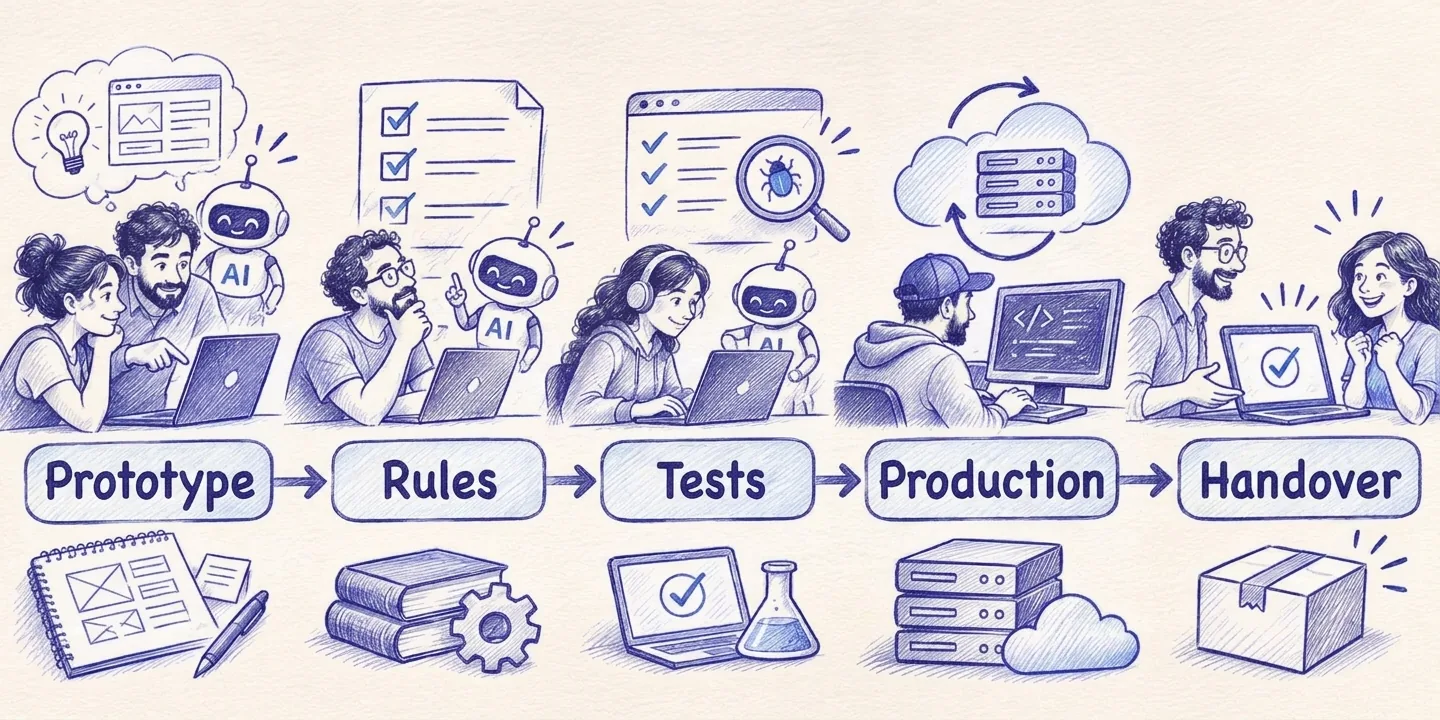
Between 2023 and 2025, most software teams treated AI as a faster autocomplete: a developer opened an IDE, typed a comment, accepted a ten-line function from a reactive copilot, and kept running the exact same two-week Scrum rituals they ran in 2018. That gave teams a 10% to 20% speed bump on typing—and almost zero improvement on total delivery time, because typing was never the bottleneck. In 2026, the gap has widened into a structural split between the Traditional SDLC (measured in weeks or months per feature cycle, bottlenecked by manual handoffs, boilerplate implementation, and post-hoc QA) and the Agentic SDLC (measured in hours or days, driven by coordinated coding agents working inside strict architectural guardrails with human steering and verification).
Moving to an Agentic SDLC does not mean firing your engineers or letting an autonomous bot push unreviewed code to main. Quite the opposite: when code generation becomes cheap and fast, software architecture, domain specifications, security boundaries, and automated verification become ten times more important. If your architecture is a tangled monolith without tests, coding agents just help you generate technical debt at five times the speed. If your architecture has clean contracts, deterministic tests, and explicit review gates, a three-person team can ship with the throughput of a fifteen-person department.
Key takeaways
- Copilots accelerated typing; the Agentic SDLC compresses the entire cycle: Reactive copilots assist one line at a time. Agentic development delegates a bounded engineering task—reading the codebase, implementing across files, writing tests, running the linter and test suite in a sandbox, and opening a verified pull request—while a senior engineer supervises decisions.
- The new 4-stage loop: 1. Goal & Architectural Spec (Human) → 2. Multi-Agent Execution in Isolated Worktrees (Agents) → 3. Decision & Diff Review (Human) → 4. Autonomous Testing & Production Telemetry (Agents + CI).
- Specifications are the new source code: Agents fail when given vague one-line tickets (“add Stripe webhooks”). They excel when given an architectural brief with exact invariants, edge cases, and acceptance tests.
- Code review shifts from syntax to invariants: Automated linters, typecheckers, and review agents catch syntax and style issues before a human ever sees the PR. Human reviewers focus on data models, security boundaries, failure modes, and business logic.
- Architecture determines agent leverage: Modular repositories with strong TypeScript/Python typing, fast local test suites, and seedable databases get 3x–5x cycle compression; tightly coupled legacy repos without tests get almost none.
Traditional SDLC vs. Agentic SDLC: phase-by-phase comparison
To understand why some engineering teams ship production features in forty-eight hours while others take six weeks for the same scope, compare what happens at each stage of the lifecycle:
| SDLC Phase | Traditional SDLC (Manual + Reactive Copilot) | Agentic SDLC (2026 Coordinated Loop) | Cycle Time Compression |
|---|---|---|---|
| 1. Discovery & Specification | PM writes a 3-sentence Jira ticket; engineers discover missing edge cases halfway through week 2 of coding. | An exploration agent maps affected files, DB schemas, and callers in 3 minutes; the Architect/PO locks down invariants and edge cases before code is written. | 2–4 days → 1–2 hours |
| 2. Implementation | One developer writes code file by file, context-switching between frontend, API, migration, and docs. | Parallel coding agents work in isolated Git worktrees: one builds the schema & API, another builds the UI and integration tests against the contract. | 5–10 days → 2–6 hours |
| 3. Verification & QA | Developer writes a few happy-path unit tests; QA team tests manually in staging days later and files bug tickets. | Agent loop cannot finish until typecheck, unit tests, property/edge-case tests, and Playwright E2E checks pass inside its sandbox. | 3–5 days → 15–45 minutes |
| 4. Code Review | Senior dev spends 45 minutes nitpicking formatting, missing null checks, and obvious regressions. | An adversarial review agent checks OWASP rules, migrations, and test coverage first; the senior engineer reviews a clean, pre-verified diff focused on architecture. | 1–3 days wait → 30 minutes |
| 5. Deployment & Observation | Manual release notes, reactive pager alerts when an edge case breaks in production. | Telemetry agent watches error spikes and latency post-deploy, correlates stack traces to the commit, and drafts a hotfix PR with a reproduction test before the engineer opens their laptop. | Hours of triage → 10 minutes |
The total cycle does not shrink from three weeks to one day because anyone is working frantic sixteen-hour shifts. It shrinks because queue time, context retrieval, boilerplate wiring, and manual test setup disappear.
The 4 stages of the Agentic SDLC in practice
When I set up an Agentic SDLC for my own products or for client engineering teams, we organize work around four explicit stages: Goal & Architecture → Agent Execution → Human Review → Autonomous Testing & Observation.
Stage 1: Goal and architectural specification (Human-led, agent-assisted)
In the Traditional SDLC, specifications were often treated as ceremony because writing code by hand took so long that requirements drifted anyway. In the Agentic SDLC, the specification is the highest-leverage artifact a senior engineer or Product Owner writes.
Before launching an implementation agent, the human lead defines four things in a short Markdown spec (typically 30 to 60 lines):
- The business goal and non-goals: What problem we are solving—and explicitly what we are not changing in this PR.
- Data and API contracts: Exact database columns, TypeScript interfaces or OpenAPI/Zod schemas, idempotency rules, and permission checks.
- Failure and edge-case invariants: What happens when the webhook arrives twice? What happens when the external API returns HTTP 429? Which tenant role is forbidden from calling this route?
- Verification command: The exact terminal command (
pnpm test:integration && pnpm astro check) that must exit with code0before the agent is allowed to report completion.
We use a read-only Codebase Research Agent to do the legwork for this spec: in two minutes, it searches the repository, lists every file and database table touched by the change, and flags existing patterns so the spec matches the codebase’s conventions. See Claude agents for how file-level project instructions (CLAUDE.md / AGENTS.md) make this step repeatable across the whole team.
Stage 2: Coordinated agent execution in isolated worktrees
Once the spec is approved, we do not run a single bloated chat session that tries to edit forty files at once. We fan out bounded tasks across specialized agents running in isolated Git worktrees (so two agents never overwrite each other’s working directory):
- Implementation Agent (Backend / Domain): Implements the migration, service layer, and API endpoint inside its worktree, iterating against the compiler and unit tests until green.
- Implementation Agent (Frontend / UI): Builds the components and form states against the typed contract.
- Test & Adversarial Agent: Reads the spec—not the implementation agent’s rationalizations—and writes edge-case tests: duplicate payloads, unauthorized tenant IDs, malformed inputs, and timeout simulations.
Each agent runs inside a sandbox with a tool loop: edit code → run typechecker and tests → read compiler/test output → fix errors → repeat until all checks pass. The human engineer does not babysit every keystroke; they let the loop converge on a passing test suite.
Stage 3: Human review (Decision supervision, not syntax checking)
Here is the golden rule of the Agentic SDLC: an AI agent never merges to main on its own, and no human merges a pull request they do not understand.
When an agent finishes its worktree task, it opens a pull request containing:
- A concise summary of the architectural decisions made.
- The diff, kept intentionally small (under 300–400 lines per PR whenever possible).
- The test execution log proving all new and existing tests pass.
Before the human Tech Lead reviews the PR, an automated Security & Architecture Review Agent scans the diff against a strict checklist:
- Are there any N+1 database queries or unindexed lookups?
- Is tenant isolation (
tenant_id) enforced on every read and write query? - Are secrets, PII, or raw stack traces ever leaked in logs or HTTP responses?
- Do the new tests actually assert business behavior, or did the implementation agent write tautological mocks that always pass?
Notice that last check: agents love to make failing tests pass by weakening the test assertion or mocking out the bug. Catching tautological tests is one of the most important jobs of the review stage. When the senior engineer sits down to review, they spend twenty focused minutes evaluating the data model, the test assertions, and the edge-case behavior—not hunting for missing semicolons.
Stage 4: Autonomous testing and production observation
In a traditional pipeline, QA happens at the end of the sprint and slows down release velocity. In an Agentic SDLC, verification runs continuously before and after merge:
- Deterministic contract and regression suites: Fast unit and integration tests run on every agent turn in seconds.
- Browser and workflow E2E verification: Headless browser checks verify critical user journeys (checkout, lead submission, login, permissions) on preview deployments before merge.
- Post-deploy observability triage: When a new release ships to production, an observability agent monitors error rates, p95 latency, and database query timings (
Server-Timingheaders and application logs). If a new exception appears, the agent correlates the stack trace with the exact commit diff, reproduces it in a test, and posts the root-cause analysis (and a draft revert or fix PR) to the engineering channel.
Making your repository “Agent-Ready”: the 6-point architecture checklist
Why do some teams try coding agents and conclude “they only work for toy greenfield apps; they break our production codebase”? Because their codebase relies on tribal knowledge stored only in the heads of two senior developers who have been there since 2019.
An agent can only reason about what is explicit in the repository. When I prepare a client’s codebase for an Agentic SDLC, we invest the first week in six concrete structural upgrades:
- A root
AGENTS.md/CLAUDE.mdarchitectural constitution: A 100-to-150-line file at the root of the repo that documents the exact build/test commands, directory responsibilities, database conventions, security rules (“never use raw SQL strings,” “every route must callrequireTenantAuth”), and non-negotiable constraints. - End-to-end static types and runtime schema validation: Strict TypeScript (
strict: true), Zod/Valibot schemas at API boundaries, or typed Python (Pydantic + mypy/pyright). Compiler errors are the fastest, cheapest feedback signal an agent loop can receive. - Sub-10-second local test execution: If running a single test file takes three minutes and requires five external staging servers to be online, an agent loop grinds to a halt. Fast, hermetic local tests (using SQLite/in-memory Postgres fixtures or deterministic test containers) turn a sluggish agent into a surgical one.
- Small, cohesive modules with explicit boundaries: A 4,000-line “god file” blows up the agent’s context window and causes accidental edits. Splitting domain logic into focused 150-to-300-line modules with clear exports keeps context sharp and diffs easy to review.
- Deterministic database migrations and seed data: Give agents a single command (
pnpm db:reset:test) to spin up a clean schema with realistic, anonymized seed data so they can verify their own queries and UI changes without touching shared environments. - Hard pre-commit and CI gates: Block any commit or PR that lowers test coverage on critical paths, introduces
anytypes, modifies protected security middleware without explicit CODEOWNERS sign-off, or fails static security scans.
For a deeper look at how we structure modern software projects around these principles, see Software development in the AI era.
The economics: AI FinOps in the software lifecycle
As teams shift from a €20/month autocomplete subscription to multi-agent execution loops, AI compute becomes a real line item on the engineering P&L. A careless developer who spawns five parallel Opus-class agents on a poorly specified task can burn €40 to €80 in API tokens in an afternoon—and produce a 2,500-line pull request that gets rejected in code review.
High-performing engineering teams in 2026 apply three simple FinOps rules to their Agentic SDLC:
- Match model tier to the SDLC phase: Use frontier reasoning models for Stage 1 (Architectural Spec & Planning) and Stage 3 (Adversarial Security & Logic Review), where one good decision saves ten hours of rework. Use faster, mid-tier coding models for Stage 2 (Routine Implementation & Test Writing) once the spec and file paths are already locked down.
- Cap diff size and agent turns per task: If an coding agent has not converged on a passing test after 12 to 15 tool turns, stop the loop automatically. Almost always, a stalled loop means the task is too big or the specification is contradictory. Break the task into two smaller PRs instead of burning another 200,000 tokens.
- Measure cost per merged, defect-free PR: Just as production business agents are measured on cost per completed task, coding agents are measured on cost per merged PR that survives 30 days in production without a rollback or bug fix. Generating 10,000 lines of unmerged code is waste, not velocity.
Three anti-patterns that wreck an Agentic SDLC
If you are rolling out agentic workflows across your engineering team this quarter, guard against three traps I see repeatedly:
- “Vibe coding” in production systems: Letting developers prompt an agent with a vague sentence and merge whatever compiles without reading every line of the diff. That works for a weekend prototype and creates catastrophic security and data-integrity bugs in a real business. Rule: The human whose name is on the PR owns every line of code in that PR, whether they typed it or an agent generated it.
- Flooding the review queue with giant PRs: When writing code gets 4x faster, the bottleneck immediately moves to senior engineer code review. If three developers use agents to open twelve 1,500-line PRs on Tuesday morning, your Tech Lead will drown by Tuesday afternoon. Rule: Enforce small, atomic PRs (one migration, one endpoint, one UI slice) and use automated review checks to filter out flawed PRs before a human is pinged.
- Skipping architectural documentation: When agents read stale docs or old dead code in the repo, they faithfully copy your worst deprecated patterns into new features. Rule: Deleting dead code and keeping
AGENTS.mdcurrent is now high-leverage feature work.
What to bring to a first conversation
If your engineering team feels stuck between the hype of autonomous coding agents and the reality of a complex production codebase—or if your delivery cycle still takes four weeks for features that should take three days—bring your current repository structure and your team’s last five pull requests. In a focused architecture and workflow session, we can identify what is slowing down your cycle, make your codebase agent-ready, and set up a disciplined Agentic SDLC with the right review and testing gates.
Sources
- Anthropic Engineering — Claude Code Best Practices for Agentic Coding
- DORA (DevOps Research and Assessment) — Accelerate State of DevOps Report: AI in Software Delivery
- Martin Fowler / Thoughtworks — Exploring Generative AI in Software Architecture and SDLC
- OWASP Secure Coding Practices & LLM Application Security