Management in the AI era: how to reorganize work across a team
A practical plan for managers introducing AI to the team: task selection, quality indicators, approval rules and a 30-day pilot.
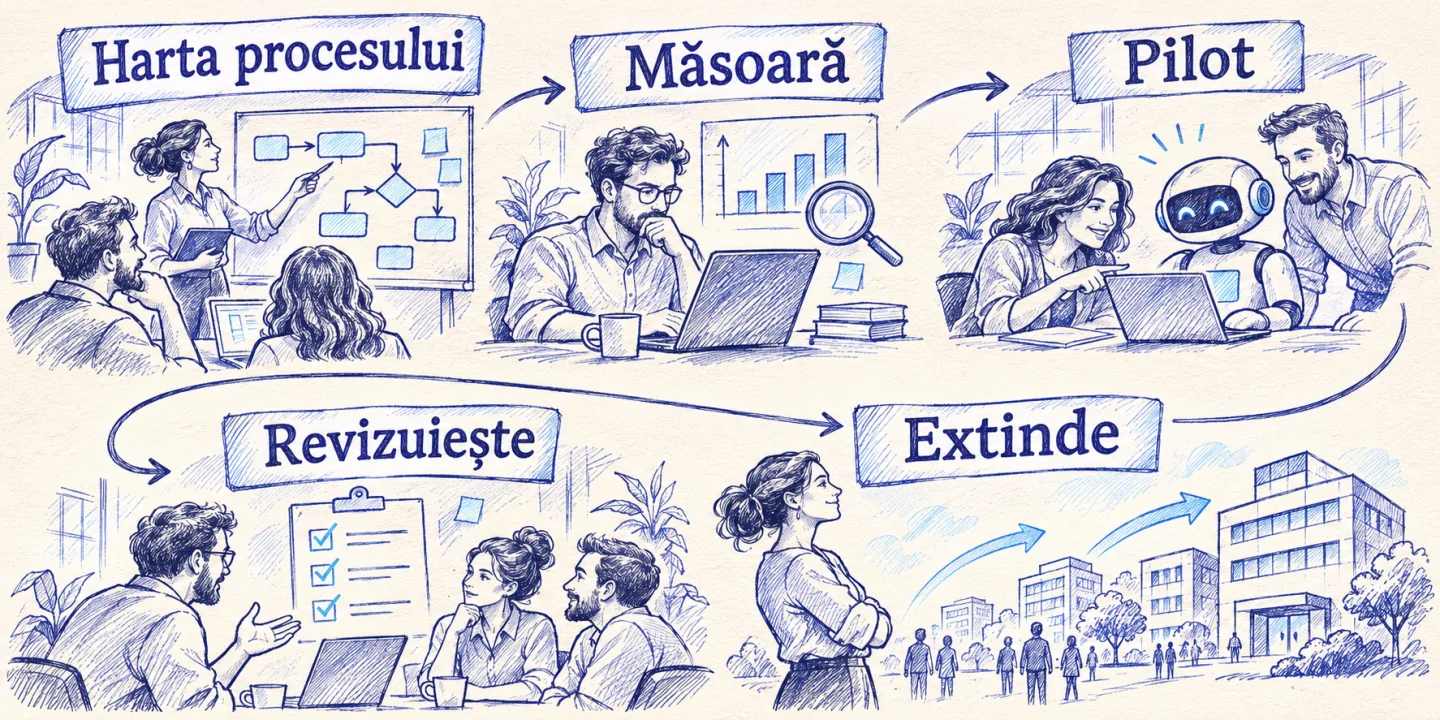
Managing in the age of AI means redefining tasks, decisions and responsibilities around a tool that quickly produces verifiable results. A manager should start with a repeatable process, measure its current performance, and test a small intervention with an owner, an escalation rule, and stop criteria.
Imagine a sales department that receives requests in different formats. The team wastes time searching for missing information and preparing summaries. A model can order messages and propose clarifying questions. The whole team knows if the project matches the offer and if the promised deadline is realistic. Only this division of labor turns a text-generating function into an operational change.
What is changing in the role of the manager?
The first change is that tasks become the design unit. A role like “support manager” includes reading, searching, responding, negotiating and remediation. Each requires a different combination of information, authority, and judgment. If adoption is only discussed at the role level, the team will over-delegate or reject the tool en masse. If it is being discussed at the task level, you can spot test where a good summary frees up time for difficult conversations.
The second change is that verification becomes explicit work. Who controls the sources, who sees an exception, and who can stop a stream? If responsibility remains implicit, the last person in the chain bears the cost of the decision, even if they did not have access to the data used. A manager needs to put access, authority and check time in the same place.
The third change concerns investment. The license is easy to buy and easy to count. Time spent on revisions, differences between teams and effects on the customer are harder to see. Make room for these signals in the weekly report, before the number of active users becomes a substitute for the value produced.
How do you choose the first process for AI?
It looks for a process that meets three conditions simultaneously. It repeats enough to measure it, has previous examples for comparison, and allows the result to be corrected before external effects. Categorizing requests, extracting information into an internal form, or preparing a project summary are good candidates. The approval of a contractual exception or the evaluation of a person requires a separate analysis.
It maps the flow as it happens on a busy day. Ask a colleague to show you the last common case and the last failed case. It notes the actual input, open applications, when a response is expected, and where the result is checked. A waste of time can come from a missing permission or two duplicate approvals. In that case, providing access or removing an approval can fix the problem at the source.
Then choose a verifiable sentence for the pilot. For example, for requests received on the form, the team can find the missing fields and prepare the first clarification faster, with the same rate of important corrections. It includes the type of request, the beneficiary and the business consequence. The promise “the team will be more productive” leaves too much room for interpretation.
What do you delegate and what do you manually approve?
| Pregnancy | AI intervention | Team control |
|---|---|---|
| Organizing an application | Extract fields and flag unknowns | Check the source and correct the omissions |
| Preparing a message | Propose a contextual draft | Approve the tone, term and amount |
| Resource planning | Group declared dependencies | Decides allocation and negotiates priorities |
| Contractual exception | Searches for permitted documents and presents options | The person with authority decides |
| Data incident | Prepare a timeline from approved journals | The assigned team limits the incident and decides the communication |
Real approval requires context and right of refusal. In the business example, the person needs to see the customer message, the draft, and the fields that the system has assumed. A single green button interface quickly makes control routine. If you notice that almost no one rejects or changes the result, ask how the review is done and check an independent sample. A high approval rate may indicate a good feature or a screen that is being mechanically passed.
It documents who can loosen restrictions and under what conditions. For example, switching from draft to automatic sending deserves a separate decision with simulation, a small group of recipients and a rollback procedure. In flows with effects on employees or customers, involve data protection and compliance persons before the change of purpose.
How do you measure real productivity?
It measures the time between case entry and usable output. Generation time is a technical indicator. Operational indicator includes read, check, edit, approve and rollback for errors. If the pattern ends in a few seconds, but the result forces a specialist to open three additional sources, the win can disappear.
It uses at least two dimensions: time and quality. For triaging requests, quality can mean routing to the right person and preserving important details. For a commercial draft, criteria can include the right tone, the right prices, and no commitments without approval. It defines what difference rework makes and what difference can damage. An omitted comma and an unconfirmed term do not carry the same weight.
Separate simple cases from exceptions. A pilot can look great if it only uses well-filled prompts. In exploitation you have duplicate requests, mixed languages and messages that change the subject halfway through. It includes such situations in the evaluation, but presents the results separately to see where use is justified. Compare similar batches and note changes in volume or personnel.
If benefits arise, decide where the earned time goes. An operator can use it for deferred calls, an engineer for defect reduction, a manager for unlocking decisions. State explicitly what outcome you’re after. When free time automatically turns into multiple requests on the same day, the team can end up with less autonomy and a higher review load.
What does a 30-day pilot look like?
In the first week, establish a process manager, a technical manager and people who review the results. Choose a sample of cases and note the time, delays and mistakes in the regular flow. Check what data reaches the provider. Establish a channel where colleagues can report a problem without hiding it in a private conversation.
In the second week, run on allowed historical examples or similar fictitious data. Report behavior by request category. Emphasize cases where the system should ask for clarification. A helpful assistant can state their limits and pass on the problem. Adjust the instructions and interface based on discussions with the people who will use them.
In the third week, use the result as a proposal in a small group. Save a trail of decisions without needlessly copying sensitive data to logs. Require reviewers to distinctly mark corrections that change a decision. If results are poor on a request type, remove the type from the pilot and keep it in the evaluation set.
In the last week, compare the results with the reference. Document what went well, what cost more, and what incident would trigger the shutdown. An extension decision must include the person responsible for the following month, the consumption limit and the date of the next assessment. If the data are too few or the benefit differs greatly between individuals, a smaller pilot may be more informative than a company-wide expansion.
How do you keep the trust of the team?
It explains the purpose, the data used and what happens with the feedback. People will report mistakes if they know that the observations help them change the process. If they suspect that each correction becomes an individual score, they will find ways to bypass the tool or finish the check outside of it. Process measurement and individual assessment have different purposes and must remain clearly demarcated.
Invite the people performing the task to propose examples and cases of refusal. They know, for example, when a seemingly trivial delay indicates a delivery promise already broken. Show what observations you turned into rules and come back with the results. When explaining a procedural change, use a real anonymized request and show where intervention is needed.
Do applied training. A half-hour session can cover several situations the team often encounters, including data they are not allowed to send, an incorrect result, and reverting to manual flow. Keep examples accessible after the session. For roles that already approved an outcome, explicitly practice contesting the system’s proposal. When a new colleague joins the team, they must also be able to learn the basic process.
What decisions are worth keeping in the pilot’s record?
Record the purpose, scope, responsible person and version of the system. For each incident, note the category, impact, what was done for the customer or user, and how you are verifying the effect of the remediation. Keep the hypotheses you haven’t tested separate. This minimum makes possible a management discussion after a model change, a new team or the departure of the person who built the prototype.
An example of a useful boundary is “the system can propose a direction, but does not move the request outside the organization.” A stop rule could be finding a single instance where a restricted piece of information ends up in a draft for the wrong team. In this case, the effect matters, even if most of the propositions were correct. For several types of risks, the NIST Profile for Generative AI provides a working vocabulary.
Also review the cost promise. If in the third week the time to clean up the entries increases, see if the process needs a better form. If the check remains difficult to explain to a colleague, simplify the result. If autosort only works when people type in a template they already use, try regular rules for standard fields first. They are often sufficient for a segment of the stream.
How do you distribute budget and responsibility in a small team?
A pilot budget can have three parts: setup, review capacity, and remediation reserve. If all resources are allocated to the installation, the team will not have time to notice what changes in the actual work. Block times in the calendar for the examination of selected cases. In a small company, the same person may have several responsibilities, but it must be clear when they act as the author of the automation and when they act as the person in charge of the process.
Imagine that a pilot saves time in triage and yet mishandles requests containing multiple intents. You can keep the automation for messages with a clear intent and send the rest to the operator. The remaining budget can improve the form so that people can better categorize complex requests. This decision uses the observed results, maintains the benefit and reduces the amount of corrections.
At the decision meeting, ask for two or three cases to be presented, not just average ones. A successful example shows that the output is usable. A patch example shows what an operator can fix. A stop example shows where it is not worth continuing. Assign each next step a person and an outcome measure, including checking the effect on daily activity.
Frequently asked questions
Where does a manager start without a technical team?
Pick a small stream, inventory the samples, and measure the reference. You can test draft in an approved tool with allowed information before purchasing integrations. When you need the system to retrieve data from multiple applications or modify records, define permissions and discuss implementation with a specialist.
Who is responsible for an AI prepared decision?
The organization must designate the person who has the authority and resources to make the decision. The model can order evidence or suggest text. The process must say who approves, who can refuse and where the situations that go out of the norm end up. The reviewer must see enough evidence to be able to dispute the proposal knowingly.
When do I expand the pilot to other teams?
When the improvement remains visible in comparable cases, the total cost is known and there is a return procedure. Check out the new team separately. It may receive other types of data or have a different responsibility to the client. And if the change calls for wider access, treat it as a new decision.
What if people don’t use the solution?
Watch some head-to-tail cases. If the tool asks for too much data, forces the user to jump between apps, or delays approval, the team has practical reasons to avoid it. If the issue is trust, clarify who sees the history and what actions the system produces. A test with real tasks shows more than a satisfaction survey.
From the pilot to a management decision
Take a small set of representative examples, the pilot results and two alternatives to the next meeting. One may be to extend the original purpose, the other to retain a single useful function. Put beneficiaries, recurring costs and consequences of failure in the same document. A good decision makes visible the trade-offs the team is making, including situations where the technology must be retired.
If the project already has users and you are looking for a common way of working between business, product and engineering, see the service of Product Owner and Tech Lead. For post-launch behavior evaluation, also read Guide to AI Systems in Production. A useful discussion starts with a complete case, with input, decision, outcome and who is responsible for each step.