MCP vs. A2A: What a Founder and Architect Actually Need to Know
Anthropic's Model Context Protocol (MCP) and Google's Agent2Agent (A2A) solve two completely different problems. How they work together, when a single agent with MCP is enough, and when multi-agent A2A pays off.
Every week in 2026, a founder or CTO asks me some version of the same question: “We just finished wrapping our internal APIs in MCP servers—do we now need to rewrite them for A2A, or pick one standard over the other?” The short answer is no. Model Context Protocol (MCP) and Agent2Agent (A2A) do not compete for the same layer of your stack. MCP is how an agent uses a tool or data source (like a wrench, a database query, or an ERP endpoint). A2A is how one autonomous agent delegates a multi-step job to another opaque agent across team, system, or vendor boundaries (like a project manager hiring an external specialist).
Understanding where one protocol ends and the other begins saves months of over-engineering. For roughly 80% of mid-market B2B workflows, a single well-bounded agent connected to three or four internal MCP servers is faster, cheaper, and far easier to debug than a fleet of agents talking over A2A. For the remaining 20%—where separate departments, separate security perimeters, or third-party SaaS platforms each run their own agents—A2A prevents you from handing raw database credentials across organizational boundaries.
Key takeaways
- MCP is vertical (Agent → Tool); A2A is horizontal (Agent ↔ Agent): MCP connects a model to deterministic functions, schemas, and files. A2A connects an orchestrating agent to a peer agent that has its own private memory, model, and tools.
- Do not use A2A when a function call is enough: If the target system just needs to look up an invoice or update a row in PostgreSQL, wrap it as an MCP tool. Turning simple CRUD endpoints into “agents” adds latency, token cost, and non-determinism for zero benefit.
- Use A2A across trust and ownership boundaries: When Agent A (owned by Customer Support) needs work done by System B (owned by Finance or an external logistics vendor) without exposing System B’s internal database tools or prompts, A2A provides a clean task-and-artifact boundary.
- Security models differ fundamentally: MCP security is about tool-call least privilege and context size; A2A security is about mutually authenticated task contracts, asynchronous state transitions, and zero-trust delegation.
- Start with MCP, graduate to A2A only when tool counts or organizational boundaries force the split.
Two protocols, two different layers of the stack
Before MCP gained industry-wide adoption across Anthropic, OpenAI, Cursor, Cloudflare, and enterprise IDEs, every AI integration required custom glue code to translate a database or SaaS API into a model-specific tool definition. MCP standardized that agent-to-tool interface: an MCP server declares its tools, resources, and prompts using JSON-RPC, and any MCP-capable host can discover and call them deterministically.
As companies moved from single assistants to multiple specialized agents, a second problem appeared. Suppose your company runs a custom Order Operations Agent on your own infrastructure, your accounting platform runs a Tax & Reconciliation Agent, and your logistics partner exposes a Customs & Freight Agent. You cannot—and should not—plug the logistics partner’s raw database tools directly into your internal agent via MCP. Their agent has its own proprietary reasoning loop, its own rate limits, and its own confidential data, and some tasks take twenty minutes of asynchronous background work rather than a 300-millisecond RPC call.
That is the layer Agent2Agent (A2A)—introduced by Google and backed by enterprise SaaS and consulting partners—was designed to standardize: how an agent discovers what another agent can do (via an /.well-known/agent.json Agent Card), submits a long-running task, exchanges clarification messages or status updates over Server-Sent Events (SSE), and receives a verified output artifact when the job completes.
| Dimension | Model Context Protocol (MCP) | Agent2Agent Protocol (A2A) |
|---|---|---|
| Primary relationship | Agent → Tool / Data resource (hierarchical) | Client Agent ↔ Remote Peer Agent (peer-to-peer) |
| What sit on the other end? | Deterministic code: APIs, SQL queries, file systems, sandboxes | Another autonomous agent with its own LLM, memory, and internal tools |
| Transparency vs. Opacity | White-box interface: The agent sees exact function names and JSON input schemas | Black-box execution: The caller sees capabilities and task status, never the peer’s internal tools or prompts |
| Typical execution duration | Synchronous milliseconds to seconds (tools/call) |
Seconds to hours/days (tasks/send, streaming updates, webhooks) |
| Discovery mechanism | tools/list and resources/list over an established MCP session |
HTTP discovery via /.well-known/agent.json (Agent Card) |
| State management | Stateless tool invocation (host holds conversation state) | Stateful task lifecycle (submitted, working, input-required, completed, failed) |
| Best business analogy | Giving an employee a calculator and a read-only CRM login | Sending a work order to another department or an external contractor |
How MCP and A2A work together in a real architecture
To see why you rarely choose between MCP and A2A, consider a concrete B2B eCommerce scenario: automated B2B quote and credit approval for custom wholesale orders.
When a wholesale buyer requests a €45,000 custom order with Net-30 payment terms, three distinct domains are involved:
- Catalog & Pricing (Domain 1): Checking stock across two warehouses, calculating volume tier discounts, and verifying margin floors.
- Credit & Compliance (Domain 2): Checking the buyer’s payment history in the accounting ERP, pulling credit-bureau risk scores, and verifying EU VAT / sanctions lists.
- Sales Account Owner (Human in the Loop): Reviewing the assembled quote package and clicking “Approve & Send.”
If you try to build this as one giant agent with 45 MCP tools from every department (Warehouse SQL, Shopify B2B, NetSuite ERP, Stripe, Credit Bureau API, VIES VAT API, SendGrid), two things go wrong immediately:
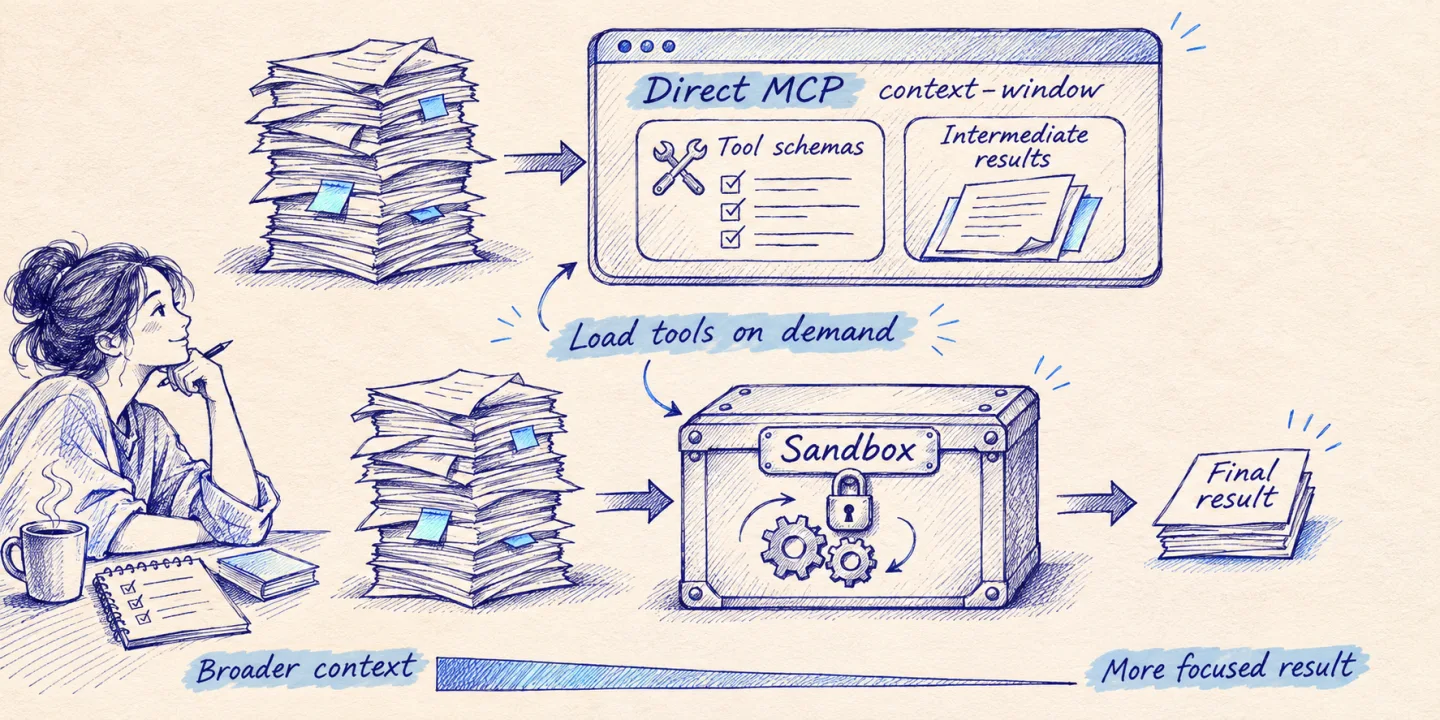
- Context bloat and tool confusion: As I showed in MCP Tool Calls vs. Code Execution, loading 40+ tool schemas degrades tool-selection accuracy and burns tens of thousands of tokens before the agent does any work.
- Broken security perimeters: Your sales-facing agent now holds credentials capable of querying sensitive financial and credit records inside the accounting ERP.
Here is how a clean 2026 architecture combines MCP inside each domain with A2A between domains:
[Wholesale Buyer Request]
        │
        ▼
┌─────────────────────────────────────────────────────────┐
│  1. Sales Quote Agent (Orchestrator)                    │
│     ├─ via MCP ──► Warehouse Stock API (read-only)      │
│     ├─ via MCP ──► Pricing & Margin Calculator (code)   │
│     └─ via A2A ──► Sends Task: "Evaluate Net-30 Credit" │
└─────────────────────────────────┬───────────────────────┘
                                  │  (Zero-trust HTTP boundary:
                                  │   No ERP credentials shared)
                                  ▼
┌─────────────────────────────────────────────────────────┐
│  2. Finance & Risk Agent (Separate Service / Perimeter) │
│     ├─ via MCP ──► Accounting ERP (overdue invoices)    │
│     ├─ via MCP ──► EU VIES & Credit Risk API            │
│     └─ Returns A2A Artifact: { decision, limit_eur }    │
└─────────────────────────────────────────────────────────┘
In this design:
- MCP does the heavy lifting inside each boundary: The Sales Quote Agent uses MCP to call fast, deterministic inventory and margin calculation tools. The Finance & Risk Agent uses its own private MCP server to query the accounting ERP.
- A2A enforces the boundary between departments: The Sales Quote Agent never sees the raw ERP tables or the Finance team’s proprietary risk rules. It simply sends an A2A task (
evaluate_credit_limitforcompany_vat_idandrequested_net30_eur: 45000) and receives back a signed JSON artifact (status: "completed",approved_limit_eur: 50000,risk_tier: "low",audit_ref: "fin-2026-8841").
What each protocol looks like in code
For a non-technical founder, it helps to see how small the contract difference actually is—and why your engineering team should not overcomplicate either one.
An MCP tool definition (Agent calling a deterministic function)
An MCP tool is a strict function signature. The agent must supply exact parameters, and your code executes a predictable query:
{
  "name": "calculate_wholesale_margin",
  "description": "Calculate net margin percentage and minimum allowed price for a list of SKUs and quantities. Deterministic calculation; does not modify state.",
  "inputSchema": {
    "type": "object",
    "properties": {
      "customer_tier": { "type": "string", "enum": ["standard", "gold", "distributor"] },
      "lines": {
        "type": "array",
        "items": {
          "type": "object",
          "properties": {
            "sku": { "type": "string" },
            "quantity": { "type": "integer", "minimum": 1 },
            "proposed_unit_price_eur": { "type": "number" }
          },
          "required": ["sku", "quantity", "proposed_unit_price_eur"]
        }
      }
    },
    "required": ["customer_tier", "lines"]
  }
}
An A2A Agent Card and task request (Agent delegating to another agent)
In A2A, the remote agent publishes an Agent Card (/.well-known/agent.json) declaring its high-level skills, authentication scheme, and supported input/output modes—not its internal database schemas:
{
  "name": "Finance Credit & Compliance Agent",
  "description": "Evaluates B2B Net-30/Net-60 credit requests against ERP payment history, VIES VAT status and credit policies.",
  "url": "https://finance-agent.internal.example.com/a2a",
  "version": "1.2.0",
  "authentication": { "schemes": ["Bearer", "mtls"] },
  "capabilities": { "streaming": true, "pushNotifications": true },
  "skills": [
    {
      "id": "evaluate_b2b_credit",
      "name": "Evaluate B2B Credit Limit",
      "description": "Returns an approved credit ceiling in EUR, risk tier, and required approval level."
    }
  ]
}
Notice the difference: if the Finance team switches their internal accounting software from NetSuite to SAP next quarter, or changes their internal MCP tools, the A2A Agent Card does not change at all. The Sales Quote Agent keeps sending the exact same credit-evaluation task. That loose coupling is the real business value of A2A in larger organizations.
The founder’s decision matrix: when to stop at MCP and when to add A2A
The most expensive architectural mistake I see in 2026 is premature multi-agent orchestration—splitting a simple workflow into five A2A agents when one agent with four MCP tools would have shipped in two weeks at one-third of the token cost. Every hop between agents adds serialization latency, another model call, and another place where intent can get lost in translation.
Use this decision checklist before approving a multi-agent A2A architecture:
| Question | If “No” → Stay with single agent + MCP | If “Yes” → Consider multi-agent (A2A or local router) |
|---|---|---|
| 1. Tool count: Does the workflow require more than ~20–25 distinct tools even after consolidating endpoints? | One agent with MCP (plus deferred tool search if needed) handles it cleanly. | Split into 2–3 domain-specific agents so each agent’s toolset stays sharp. |
| 2. Security perimeter: Do different parts of the job require credentials that must never share the same runtime memory? | Scope permissions per MCP tool inside one harness. | Isolate the high-privilege domain in its own agent service behind an A2A contract. |
| 3. Organizational ownership: Are the capabilities built and deployed by separate teams or external vendors on independent release cycles? | Keep everything in one repo and one MCP server. | Use A2A so each team owns its Agent Card, evaluation suite, and deployment pipeline. |
| 4. Asynchronous lifecycle: Does a sub-task wait hours for an external check or human sign-off in another department before returning? | Simple webhook + database state machine around one agent. | A2A’s working / input-required task states and push notifications fit naturally. |
In short: earn your way into multi-agent systems. Start with one task-specific agent and well-designed API and MCP integrations. When a second department wants to plug its own domain agent into the workflow without merging codebases or sharing database credentials, introduce an A2A task boundary between them.
Security traps when connecting MCP and A2A
Whether you use MCP, A2A, or both, connecting autonomous components introduces three security failure modes that every technical audit must verify:
- Confused deputy / privilege escalation across agents: Suppose a low-privilege customer-facing agent accepts untrusted text from a web visitor and forwards it inside an A2A task to a high-privilege internal Finance agent. If the Finance agent trusts every A2A request from the customer agent as if it were an internal CFO command, a prompt injection on your public website just gained finance privileges. Fix: Pass the end-user’s original identity and trust level (for example,
caller_context: "public_unauthenticated"vs.caller_context: "verified_employee") inside signed task metadata, and enforce deterministic policy limits on the receiving agent regardless of what the calling agent asks. - Cross-agent infinite loops (ping-pong delegation): Agent A asks Agent B for clarification (
input-required), and Agent B automatically asks Agent A back, burning budget in a polite loop. Fix: Carry a correlationtrace_id, ahop_count(capped at 2 or 3 hops), and a harddeadline_timestampin the task header across every A2A and MCP boundary. - Data leakage in Agent Cards and tool descriptions: Never put internal hostnames, private customer examples, or proprietary business formulas inside public
/.well-known/agent.jsonmanifests or MCP tool descriptions. Treat tool and agent metadata as public-facing API documentation. For a deeper guide on securing permissions against untrusted inputs, read AI system security: prompt injection and permissions.
How I build MCP and A2A integrations for clients
When a company asks me to connect AI agents to their existing ERP, CRM, or eCommerce stack, we do not start by arguing over protocol acronyms. We start with the existing APIs and data boundaries:
- Week 1 — Task-shaped API & MCP wrapper: We identify the 3 to 5 concrete operations the first workflow needs, add idempotency keys, dry-run modes, and input validation, and expose them as a clean MCP server with compact responses.
- Week 2 — Single-agent production harness: We wire one task-specific agent to that MCP server, add runtime budgets and one-click human approval gates, and validate it against a 100-case golden evaluation set. See Agentic AI: from demo to production.
- Phase 2 (only when scaling across domains) — A2A domain boundaries: Once you have two or more proven domain agents (for example, Customer Support and Finance/Operations) that need to collaborate across separate permission boundaries, we expose a narrow A2A task endpoint with mutual authentication, hop budgets, and unified trace logging.
Frequently asked questions
Will A2A replace MCP in 2026 or 2027?
No. An agent still needs to query databases, read files, and call deterministic REST or GraphQL APIs—that is what MCP does. A2A only enters the picture when one agent needs to delegate a task to another agent. The two specifications explicitly reference and complement each other.
Do I need A2A if all my agents live in the same repository?
Usually not. If two specialist agents live in the same codebase, share the same deployment pipeline, and run within the same security perimeter, a typed TypeScript or Python orchestrator function (or an internal message queue) is simpler, faster, and easier to trace than an HTTP A2A round-trip. Use A2A when agents cross service, team, or vendor boundaries.
How much latency does an A2A hop add?
The HTTP/JSON-RPC transport overhead itself is only a few milliseconds, just like any microservice call. The real latency comes from the remote agent running its own LLM reasoning turns (typically 1.5 to 8 seconds per turn). That is why synchronous user-facing flows should minimize agent-to-agent hops, while background back-office flows can use A2A’s streaming and webhook notifications without hurting UX.
What to bring to a first conversation
Bring a simple list of the systems your workflow needs to read from and write to (ERP, CRM, helpdesk, database, or external partner APIs) and who owns each system. In one architecture session, we can decide which endpoints belong in a single MCP server, whether you need a multi-agent boundary at all, and how to ship the first working integration in weeks.