Preconfigured AI or custom development: which should you choose?
SaaS, pre-configured AI solution or custom development: differences in time, cost and data control, plus what to ask before you sign.
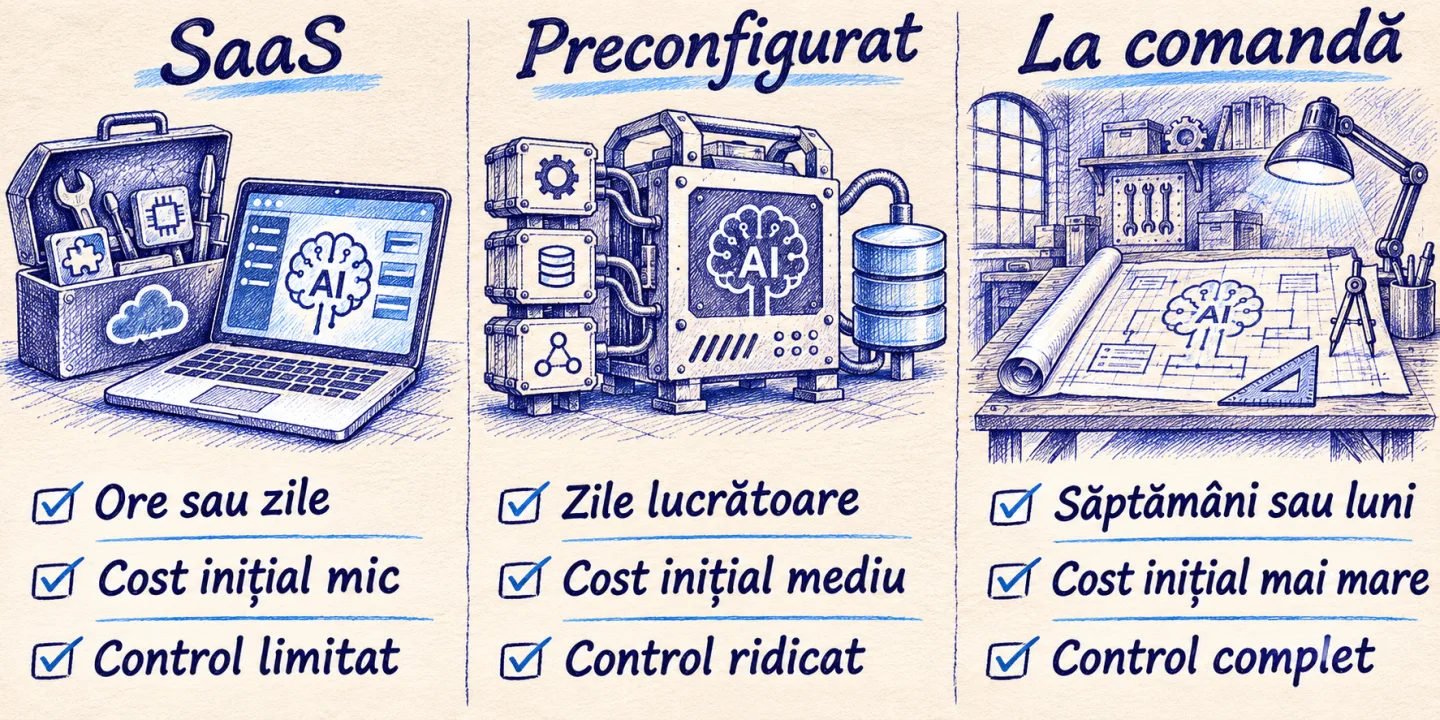
An SME that wants to use artificial intelligence has, in practice, three paths: a subscription to a ready-made tool, a pre-configured solution that links to the company’s data, or an application built from scratch. My recommendation for most small businesses: stick with an off-the-shelf tool while the need is general, switch to a pre-configured solution when the answers need to come from your data, and keep development from scratch for the processes that really set you apart from the competition. Below I explain the differences, the costs that don’t appear in the offer and the questions you should ask before you sign.
In short
- SaaS tool (subscription-based software used directly from the browser) starts on the same day, but you adapt to it, not the other way around.
- Pre-configured solution has the architecture already built and tested. It connects to your documents and programs on business days, not months.
- Development from the ground up gives you total control with the greatest value in time and money. It’s worth it when your process is unlike anyone else’s.
- The bid amount is only part of the cost. It adds up to consumption, maintenance, data cleanup, and your people’s time.
- Regardless of the option, ask in writing where the data is, whose code it is and how to leave if you are no longer satisfied.
The three roads, one at a time
The finished tool
You create an account, pay a subscription and work. This includes ChatGPT or Claude assistants, AI functions in email and office programs, chat platforms for the website. They are good for general tasks: drafting, summaries, translations, ideas.
The limit appears quickly. The tool doesn’t know anything about your business, and you can’t change the way it works. You get what the provider has decided is useful for all their customers.
The pre-configured solution
“Pre-configured” means that the hard part is already built and verified: the component that reads the documents, the one that searches them, the link to the language model, the authentication, the access rights and the log that shows who asked what. The part that is up to you remains to be done: connecting to company data, rules, tone and testing on real questions.
A handy comparison is the house on the structure. The foundation, walls and installations are ready. You choose the partitioning and finishes. It’s not a catalog house, but you don’t wait a year after the architect either.
This is how the AI solutions I offer are also thought of. A private RAG server, that is, an assistant that answers from the company’s documents (I explained it in RAG for entrepreneurs), goes live in 5–10 working days. An automated workflow takes 3–7 days, and a bot connected to company programs, 5–7 days.
Development from scratch
Here it starts from a blank sheet: analysis, design, construction, testing. You can get exactly what you want. But you also pay for parts that others have already solved many times and you wait longer to see the first result. The biggest risk is not technical. It’s finding out after three months that your people needed something else.
What can be standardized and what can’t
Everything that looks the same from one company to another is well standardized:
- loading and reading documents (PDF, Word, website pages);
- searching in them and formulating the answer, indicating the source;
- accounts, roles and access rights;
- chat log and consumption tracking;
- chat window and link to regular channels.
What is strictly related to your company is not standardized:
- data and their quality;
- the rules: who is allowed to see what and what the assistant is not allowed to say;
- connection to your billing, management or scheduling programs;
- tone and borderline cases, i.e. the rare situations where a wrong answer costs.
An honest offer separates the two. If someone promises you everything “turnkey” without asking you anything about the data, the part that matters is missing.
Direct comparison
| Criterion | SaaS tool | Pre-configured solution | Development from scratch |
|---|---|---|---|
| Time to launch | Hours or days | Business days (for me, 3–10, depending on the solution) | Weeks or months |
| Initial cost | Little or zero | Medium: You pay for plugging and fitting, not the core build | The biggest; for me, custom applications start at €1,200 |
| Monthly cost | Subscription, usually per user; grow with the team | Hosting, consumption and maintenance | Hosting, consumption and maintenance, with more to maintain |
| Control over data | Limited to what the provider allows | Raised: you decide where they sit, including on a private server | Completely |
| Flexibility | Small | Medium to large, within the limits of architecture | Maximum |
| Supplier dependency | Big | Average; it goes down if you get the code and documentation | Small, if you have the code and it’s documented |
The table shows trends, not verdicts. A SaaS tool may be the right choice for years if the need remains general.
Costs that do not appear in the offer
Consumption. Language models are paid by volume, in tokens. A token is a piece of speech; it counts both what the model reads and what it writes. The more questions and the longer the submitted documents, the higher the bill. Ask for an estimate on your volume and a monthly cap.
Cleaning data. An assistant answers as well as the documents allow. If you have three versions of the same price list, someone has to decide which is the right one. It is the most often underestimated work in such a project.
Team time. Someone from you has to answer questions, test and say “this is where it went wrong”. Without this man, the project is delayed no matter how good the supplier is.
Maintenance. Documents change, models are updated or retired, programs you’re linked to get new versions. Budget a monthly amount for maintenance from the start. For me, support starts at €250 per month.
Change provider. If the data and rules are in a format that only the provider can use, it costs you to leave. Ask before, not after.
Questions to ask before signing
- Where is my data hosted and in which country?
- Are my conversations or documents being used to train any models?
- Whose code is at the end and do I get documentation?
- What language model are you using and what if it needs to be changed?
- How much do you estimate the monthly consumption for my volume and how do we cap it?
- What is included in the maintenance and what is paid separately?
- How do I get my data back if I opt out and in what format?
- How do we measure, after the first month, if the solution is working?
- Who from me needs to attend and how many hours per week?
A serious supplier answers everything without detours. “It depends” is only an acceptable answer if it follows and what it depends on.
Three typical scenarios
Medical or dental clinic
The usual need: the front desk answers the same questions all day about the schedule, prices and preparation for the consultation, and appointments are difficult to make outside of business hours.
Recommendation: a pre-configured solution, linked to the scheduling system, with strict rules. The nurse does not give medical advice and refers any question about symptoms to a human. Health data has a stricter regime in the GDPR, so hosting and access rights are set before anything else. I wrote about assistants who talk directly to customers separately, in Chatbot AI for your business: costs and mistakes.
Online store
Common need: product descriptions, shipping and return responses, order status.
Recommendation: Start with a SaaS text tool, because you don’t need anything special there. When you want the assistant to check an order or stock yourself, switch to a pre-configured solution linked to the store platform. Developing from scratch is rarely justified here.
B2B service company
Common need: offers, contracts and procedures scattered through folders, where people search daily.
The recommendation: a pre-configured assistant that responds from internal documents, with role-based access. If the company has its own bidding process, with specific calculations and approvals, that part is built to order, over the same base. It’s the combination I recommend most often: standard base and custom automation only where the process is truly yours.
What a first deployment looks like in two weeks
An indicative plan for a responsive assistant from the company’s documents:
- Days 1–2. We establish a single use case and who will use it. We collect the documents and 20–30 real questions with the correct answers.
- Days 3–5. We connect documents, establish roles and rules. The first answers are already appearing.
- Days 6–8. We test on the collected questions. Where the answer is wrong, the cause is often in the document, not the model. We correct the source.
- Days 9–10. Two or three people in the team use it at work. We set the consumption ceiling and what we aim for in the first month.
After two weeks you don’t have a “finished” system. You have something used by real people and enough information to decide whether to extend it, adjust it, or stop it. For a small business, that’s worth more than a six-month plan.
How I work
I’ve been writing software since 2003 and building my own products, from a digital invitation platform to the online stores I manage. This is where the way I work with clients comes from: we start from a concrete problem, I choose the simplest option that solves it, and I say openly when a regular subscription is enough.
If you’re not sure which of the three paths is right for you, email me for a 20 minute chat. You tell me what you want to solve, and I tell you what I would choose in your place and why.