AI chatbots for businesses: costs, limitations and common mistakes
What an AI chatbot can do on a website or WhatsApp, what the cost consists of, when it's not worth it, 7 common mistakes and what the AI Transparency Act requires.
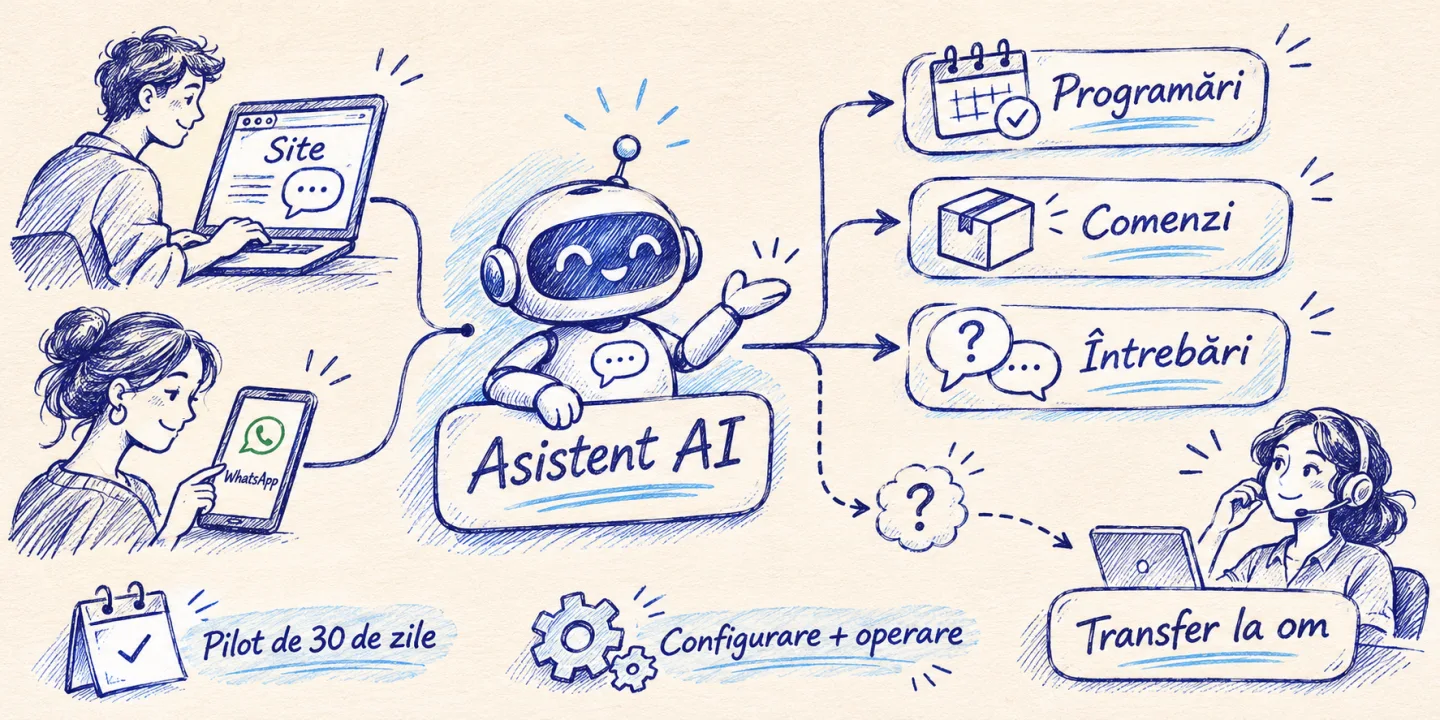
An AI chatbot on the website or on WhatsApp can take recurring questions, make appointments and check an order at any time. But it’s only worth it if you have enough questions of the same kind, up-to-date data, and a human to take over the conversations the bot can’t finish. In this article I explain what types of bots there are, what the cost consists of, what are the common mistakes, what a 30-day pilot looks like and what transparency obligations you have towards your customers.
In short
- “Chatbot” means three different things: a menu of buttons, a bot that responds from documents, and an assistant that actually does things in your systems.
- The most important part is not the bot, but the handover to the human when the bot doesn’t know or isn’t allowed to respond.
- The cost has three parts: implementation, consumption per conversation, and maintenance. It is kept under control with ceilings and a narrow domain.
- The customer needs to know they are talking to an AI. From August 2, 2026, this is also required by the European AI Regulation.
- Start with a 30-day pilot on one type of question, not “everything our customers ask.”
Three types of chatbots
| Guy | what is he doing | What does he need? | When enough is enough |
|---|---|---|---|
| Bot with buttons | A fixed menu follows: program, address, prices | A script written by you | When you have 5–10 simple questions, always the same |
| Docs responsive bot | Understand freely formulated questions and respond from company materials | Clean and up-to-date documents | When the questions are varied, but the answers already exist in writing |
| Assistant that does things | Check an order, make an appointment, recommend products in stock | Link to company programs, rules and limits | When the customer wants action, not just information |
The second type uses the method called RAG, which I explained in RAG for Entrepreneurs. The third needs an API, that is, an interface through which two programs exchange data with each other. Through it, the bot “sees” the calendar or order.
The three types can be combined. A good assistant also has buttons, for the simple things.
Niche examples
Dental clinic
The bot can tell the schedule and prices from the official list, make, move or cancel an appointment and send the pre-consultation instructions, in the form approved by the doctor.
It does not make diagnoses or recommend treatments or medications. He answers any question about symptoms in the same way: he transfers to reception or a doctor, and for emergencies he displays the phone number. This limit is written into the rules and tested before release.
Online store
The bot can tell where the order is, explain delivery and returns, recommend products that are actually in stock, and open a return request.
It does not promise discounts or change prices. Complaints and high-stakes situations like refunds go to a human.
Law firm
The bot can present the areas of practice, explain how a first consultation proceeds and what documents are useful, schedule the meeting.
It does not give legal advice or assess the odds of a case. Don’t ask for sensitive details in the chat window: professional confidentiality starts before the contract is signed. The wording of the limits is established together with the lawyer, not by the programmer.
What must exist before
- Clean data. Prices, schedule, stocks and policies in one valid version. The bot will tell you exactly what it finds.
- A system to link to. Ideally, a programming or command program with API. If you’re still working in a notebook or handheld spreadsheet, the bot can at most take the request and send it to a human.
- Written rules. What he is allowed to say, what he is not allowed to say, when he transfers, in what tone he speaks.
- A person in charge. Someone who reads the conversations in the first weeks and updates the sources.
Transfer to man, the most important part
Customers forgive a bot that says “I don’t know, I’ll put you in touch with a colleague.” They don’t forgive a bot who walks them around in circles. Therefore, the transfer is designed first, not last.
A good transfer has four elements:
- Clear Triggers: customer asks for a human, bot can’t find the answer, subject is blacklisted, customer is visibly unhappy.
- Taught context: the colleague receives the conversation so far, so that the person does not repeat everything.
- Honestly advertised schedule: outside of business hours, the bot tells when someone will answer and asks for a phone number or email address.
- Someone who actually picks up: if your transferred messages go unread, the whole project works against you.
When it’s not worth it
- You get few questions per month. A form and a phone call are enough.
- Each question is different and requires the judgment of a specialist.
- The data is messy and there is no one to put it right.
- He has no one to take over the transfers.
- Your customers prefer to call and are satisfied that way.
What does the cost consist of?
Implementation, paid only once: scenarios, connecting to sources and company programs, rules, testing. A bot connected to the company’s systems is up and running for me in 5-7 business days. The price depends on how many links are to be made.
Consumption per conversation, variable. Each message is processed by a language model, paid by volume. On WhatsApp, the rates and rules of the WhatsApp Business platform, set by Meta, are added, which we check at the beginning of the project because they change.
Maintenance, monthly: updating sources, reading conversations, adjustments. For me, support starts at €250 per month.
The cost remains predictable if you take a few simple steps:
- set a monthly ceiling at the model supplier and an alert before it;
- limit the length of a conversation;
- give fixed answers to the most frequent questions, without calling the model;
- keep your mouth shut: don’t write poems or solve homework;
- you measure the average cost of a conversation in the pilot and multiply it by the expected volume.
We discussed which build variant suits you in Pre-configured AI solutions or development from scratch.
Seven common mistakes
- You launch without handover to man. The customer gets stuck just when they need help the most.
- Let the bot answer “to the best of its knowledge”. Without company sources, it will compose plausible and wrong answers.
- Forget updates. The price has changed, the bot says the old one and the client remembers that one.
- You want it covered from day one. A narrow field done well is worth more than ten half done.
- You are hiding the fact that it is an AI. You are losing the customer’s trust, and more recently, you are also breaking a legal obligation.
- No one reads the conversations. There you find out what customers actually want and where the bot goes wrong.
- You set no limits. Neither on cost nor on topics: medical or legal advice, promises of discounts, opinions about the competition.
A 30-day pilot
- Week 1, preparation. Get real questions out of email and phones. You choose only one type, for example appointments. You write the rules and set the transfer.
- Week 2, limited release. Bot appears on one page or only outside the program. Someone reads all conversations daily.
- Week 3, adjustments. Correct sources and rules. If it goes well, you expand it a bit.
- Week 4, measuring and deciding. You continue, change direction or stop.
Indicators to watch:
| Indicator | What does it tell you? |
|---|---|
| Conversations ended without a human | How much work is the bot really taking on? |
| Transfer rate and reasons | What is missing from the sources or rules |
| Wrong answers found when checking | How much trust can you have in him? |
| Time to first response | What the customer gains |
| Appointments or orders completed | If it also brings results, not just answers |
| Average cost per conversation | If the account also comes out in high volume |
It sets the thresholds before the pilot, together with the one who builds it. Otherwise, any result will look good.
Transparency: The customer needs to know they are talking to an AI
Beyond common sense, there is now also a written rule. Regulation (EU) 2024/1689, known as the AI Act, includes in Article 50 transparency obligations that apply from 2 August 2026.
In short, paragraph 1 requires that AI systems made to talk directly to humans be designed so that the person knows they are dealing with an AI system. Exceptions are where this is obvious to a reasonably observant person, given the context. Paragraph (5) adds that the information must be clear, easy to see and given at the latest at the first interaction, respecting accessibility requirements.
Some useful clarifications:
- Who is responsible. The text puts the obligation from paragraph (1) on the responsibility of the supplier, i.e. the one who develops the system and puts it on the market under his name. As a business using the bot, you protect your customers and your reputation by verifying that the message exists and passing the requirement into the contract.
- What changed in 2026. Regulation (EU) 2026/1744, also called the “digital omnibus” on AI, has postponed several deadlines, especially for high-risk systems. The obligation to inform chatbots remained on August 2, 2026. The only respite related to Article 50 concerns the technical marking of the generated content, for systems already on the market, until December 2, 2026.
- Sanctions. Article 99 provides for the violation of Article 50 fines of up to 15 million euros or 3% of the worldwide turnover. For SMEs, the lower of the two applies.
In practice it is simple: a first message like “I am the virtual assistant of the clinic, a program based on artificial intelligence” and a label visible in the chat window. This is an engineer’s summary, not a legal opinion. For your situation, ask a lawyer.
How I work
Bots connected to company systems are part of the AI solutions that I put into operation, and when a link is needed that does not yet exist between your programs, I build it as custom automation. I start with the transfer to the human and the rules, then a pilot with pre-set thresholds. If the numbers show it’s not worth it, I’ll tell you that after 30 days, not a year.
If you want to see what an assistant could do for you, write me for a 20 minute chat. Bring the five most frequent questions you get from customers.