The future of work in the AI era: how jobs are changing
How AI is changing tasks, entry-level jobs and skills. Examples from services, technology and commerce, plus a learning plan.
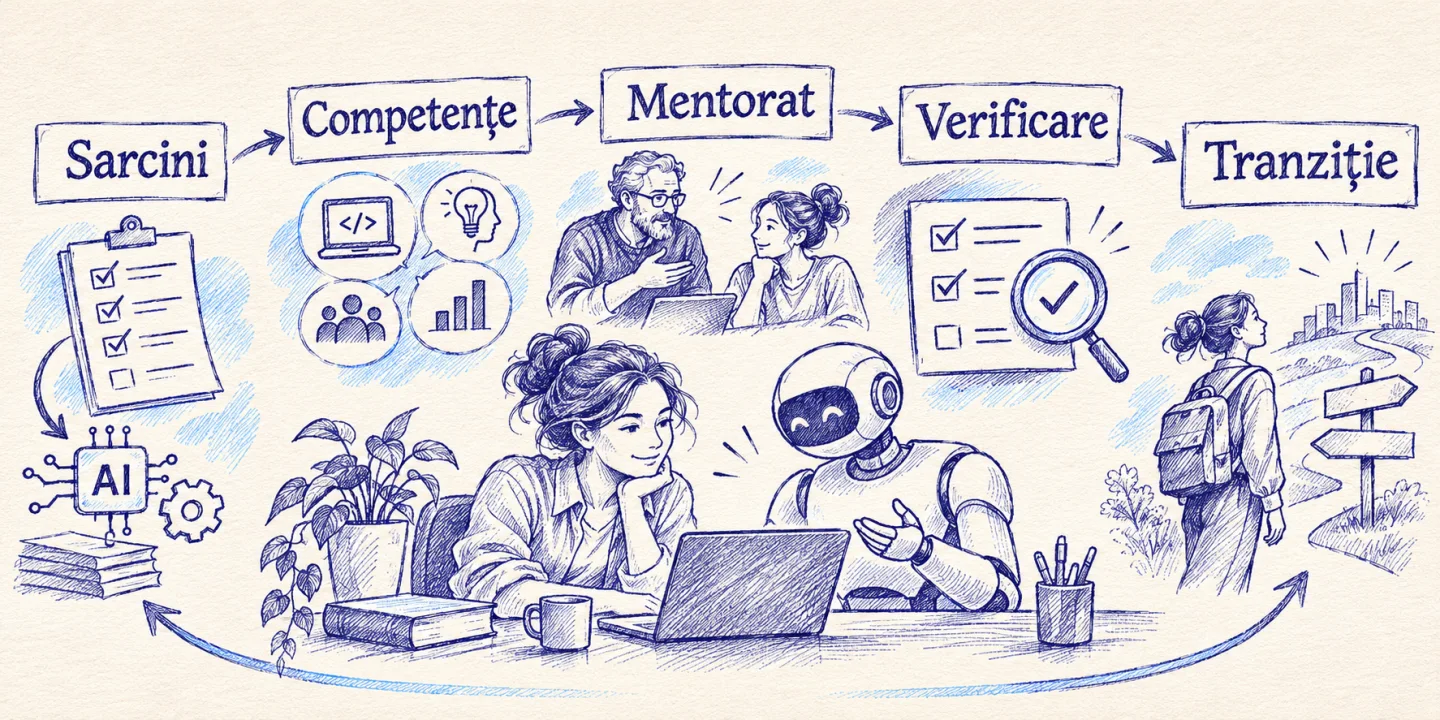
Generative AI is changing the labor market by changing tasks within professions. It can reduce the time of writing, documenting or searching. Tasks that require understanding context, setting criteria, negotiating and bearing consequences remain, and their proportion in the program may increase. The effects on employment depend on demand, how firms share the benefits and their ability to rebuild training pathways.
An administrative assistant can receive a draft report almost instantly. They still need to track approvals, check numbers and identify missing information. If the firm still requires twice as many reports, the same technology generates a different work experience than a firm that reduces unnecessary reporting. The analysis must reach the decision of the organization.
How many jobs are on display?
The International Labor Organization estimates that about one in four workers is in an occupation with some degree of exposure to generative AI. About 3.3% of global employment is in the category with the highest estimated exposure. The study examines which tasks may be affected, and the authors consider the transformation of occupations more likely than their complete disappearance, including because many tasks continue to require human input. ILO occupational index of 2025
Exposure is an indicator of potential. Adoption tells whether the tool is used in a concrete context. The employment effect shows what happens to jobs, hours, and income after other decisions come into play. Between the first two are access to technology, price, data availability and trust. Between the last two are the demand for service, bargaining power, and what the firm chooses to do with the freed up capacity.
This results in an important limitation for any local forecast. A global estimate does not say how many positions will disappear in Romania, nor in which companies. For a team analysis, start with observable tasks, the data you can use, and the market you serve. Then revise the assumptions based on the results. When someone presents a percentage of layoffs, ask if the percentage refers to occupations, positions, hours, or tasks.
What changes in day-to-day activity?
| Context | Task that AI can support | Work that gets more weight |
|---|---|---|
| Support | Researching a procedure and writing a draft | Exception resolution and customer communication |
| Commerce | Grouping complaints by topic | Identifying a product problem and negotiating a fix |
| Software | Explaining a module and proposing tests | Domain modeling and impact verification |
| Operations | Data extraction from similar documents | Correcting ambiguous cases and managing deadlines |
| Marketing | Text alternatives for the same offer | Audience research, promise picking and fact checking |
An important result is that moving from producing the first version to checking it changes the pace of work. You can receive ten proposals while writing one. Reading them all requires attention, and proposals that are close in style can make the decision difficult. For a marketing team, a brief with audience, offer, constraints and selection criteria is worth more than a request to generate as many options as possible.
In working with clients, another limitation comes from information found only in conversations and informal promises. A system can quickly piece together what’s in the applications, but the history of a relationship also includes aspects that aren’t recorded or shouldn’t be sent outside the organization. People must be able to correct conclusions and decide when a case becomes an exception. A service that hides these moments will move the mistakes to the colleagues who are talking to the customer.
What happens to entry level jobs?
Part of the exposed tasks were also learning exercises. A novice analyst notes sources and compiles reports. A programmer was fixing a local defect and reading neighboring modules. An operator observes ordinary conversations before receiving the difficult situations. If all the early activities disappear, the team must create other means by which future specialists gain context.
A useful practice is to work in pairs on real examples, with a brief explanation after each case. A junior may be given a generated proposition and two sources, then must state the assumptions, formulate a test, and explain a consequence. The senior corrects the reasoning and the effort is included in the planned capacity. In this way, the technology provides practice material and the feedback remains specific.
In recruiting, propose a representative task and explicitly say whether AI tools are allowed. Assess how the candidate has chosen sources and how they check their output. The question “what do you think would go wrong if we changed this rule?” reveals more than a test where the final result is the only criterion. For situations where candidates have different access to tools, provide the same environment or provide an equivalent variant.
An ILO synthesis of empirical research draws attention to the risks of inequality, opportunities for young workers and work organisation. A practical response in the company is to monitor how many new people have access to feedback tasks, how long it takes for them to gain autonomy, and who takes over mentoring. ILO Synthesis on Employment, Productivity and Work Organization
What skills are valuable in multiple professions?
The first is to define the problem. Describe the decision, the beneficiary, the rules that apply, and what information would change the conclusion. These are useful questions regardless of provider. In a sales team, a colleague who separates the eligibility check from the negotiation of terms can both set up a better flow and explain it to the customer.
The second is verification. If a report says that the response time has decreased, check the period, the basis of comparison and which cases were excluded. If a draft cites a rule, look up the applicable version. In software, a proposal is verified by testing behavior and reading changes. Every job has its evidence, and the habit of asking for adequate evidence carries over between fields.
The third is understanding the data. Learn to describe fields, distinguish missing values from negative values, and identify the authoritative source. Whoever knows that the date in a CRM represents the last modification and not the day of the first order avoids conclusions that even a performing model can draw from an incomplete context.
The fourth is the communication of limits. A good specialist can explain where he is confident in the result, where there is uncertainty and what step reduces the risk. The skill is useful in an email, a meeting, and a product screen. For progress, set one concrete exercise at a time. For example, rewrite a report so that the reader can immediately identify the source, period, and hypothesis.
How do you build a learning plan in 90 days?
In the first month, build a map of your own work. Write down five to ten repetitive tasks and choose one where a wrong result can be detected before it is used. Keep some examples allowed and define a check method. See how long the flow takes to cover the entire activity, including the time it takes to find a source or get an approval.
In the second month, choose a demonstrable project. An example for an operator is a list of clarification questions for incomplete applications. For an analyst, a report that separates facts from interpretations. For a developer, a small change confirmed by tests. Publish synthetic or approved materials in the portfolio, without employer documents. Explain what part you did, what tool you used, and how you found an error.
In the third month, ask for feedback from someone who would use the result. See if he understands how to apply it and where he can stop. It simplifies the route and compares the new version with the first. Write a page about what you learned, including a situation where you reverted to a manual process. At the interview you can discuss this page without divulging internal information.
If you’re short on time, work with an example you find each week. It is more important to be able to repeat the entire loop, from definition to verification, than to change the tool often. A progress trace shows two better decisions and their reasons. It also leaves room for domain knowledge, including reading the original documents and talking to people who encounter the problem.
How do you recognize changes in the quality of work?
See who can change the outcome, what happens to the pace and who gets the remaining tasks. A stream can free the operator from reading repetitive messages and, in the same month, leave only tense conversations. If the indicators only track how many tickets were closed, the real experience remains invisible. Discusses pauses, capacity and support for escalations, along with volume.
Some tasks can be shifted to people with less decision-making power. Think of a colleague who has to approve hundreds of proposals every day, but has only one option to block the entire flow. The risk should be shared with the authority. For contested proposals, he should have a place where he can explain the decision and pass the comment on to someone who can change the system.
Transition management may include in-program training, updated promotion criteria, and feedback on volume changes. In a small team, these can fit into a monthly meeting with examples and explicit decisions. For a larger organization, comparing data across teams requires the same definitions and attention to case differences. A ranking between teams working on different problems produces weak conclusions.
How do you think of three scenarios for your organization?
In the first scenario, demand remains stable and a team can finish the same volume with less effort. The management question is how to use the released capacity: for quality, development of services or reduction of working time. It measures the outcome for the customer and the effect on review volume. Time savings may be limited to a category of cases, even if the license is distributed to all.
In the second scenario, the service becomes accessible to more customers and demand increases. A service firm may produce more initial analysis, and then need more people to understand the specific situations and talk to the beneficiaries. It would be useful to track what tasks are occurring upstream and downstream. A deadlock moved from drafting to data verification requires some other form of recruitment or training.
In the third scenario, output standardises, prices fall and additional volume does not offset margins. The team needs criteria to shift resources to activities with a closer relationship with the customer or with more specialized data. For this scenario, document transferable skills and check training options before change is urgent.
No scenario is a forecast. For each, write the signals that support it and the situations that would cause you to review it. For example, it tracks deal volume, acceptance rate, review time, and demand for clarification from customers. In discussions with employees, explain what data you observe and how it will factor into decisions. Task changes are easier to manage when there are multiple ways to accommodate rather than a single promise of productivity.
What can you learn from a local example?
Imagine a distributor who receives orders by email in Romanian, English and German. A colleague spends his mornings interpreting codes and comparing quantities with the management system. The tool can suggest fields and the person checks the product, stock and price limit. The company can start with standard orders. For unusual submissions, it can keep the direct chat with the customer. In this version, language proficiency and knowledge of the catalog remain useful, and the ability to catch an exception gains additional value. Ask the person what a new colleague should learn from three such cases. The answer provides a much better clue to training than a generic list of tools.
Frequently asked questions
Will my profession disappear because of AI?
A serious review would start from your duties, application for service and applicable rules. Track changes in similar organizations and put together a plan for tasks that may become more important. A prediction about the demise of a profession cannot be inferred from mere exposure to AI.
How can I show that I know how to work with AI?
Presents a problem, decision made and proof of verification. A short example might include fictitious input data, the initial output, the error discovered, and the final output. Such material shows your domain expertise, tool usage and care for data.
What can a company do before changing job descriptions?
Map out a typical day and an exceptional day, talk to the team, then measure a small pilot. A shift in responsibilities should come after the firm understands who’s checking, who’s learning, and what happens if the tool isn’t available. For a pilot model, see Management in the Age of AI.
A benchmark for the next decision
When a promise about the future of work emerges, draw the flow that should produce it. Where does the data go in, who approves, who learns and what outcome can be measured? By applying the questions to a specific profession, you can decide which competency is worth practicing and which change is worth testing. And if you adapt a team, make visible both the outcome for the customer and the effect on the people who deliver it.